
How to Install a Bathroom Exhaust Fan the Right Way
Part of: Basic plumbing
- Difficulty
- Moderate to hard
- Time
- 3 to 6 hours
- Tools
- Drill, drywall saw, tape measure, screwdriver, wire strippers, ducting and clamps, foil tape, cable, junction box, ladder, dust sheets, PPE
- Call a pro if
- You are not confident working with household wiring, the fan needs a new circuit, or the duct route goes through a structural wall or a fire compartment.
In this guide
- Power off first
- Wear protection
A bathroom fan that vents into the attic does not remove moisture, it just moves it somewhere it will condense. Done properly, a fan keeps the room dry, stops mold and protects the paint and the door. Here is how to install a bathroom exhaust fan.
1. Size the fan
- Measure the room: length x width x height in meters gives the volume.
- Aim for at least 8 air changes an hour for a bathroom, more for a shower room.
- A fan rated in liters per second should move roughly the room volume every few minutes.
- A humidistat or timer model is worth the extra, because people switch fans off too early.
- Check the duct run: a long or bendy run needs a stronger fan.
2. Plan the route
1. Decide where the fan goes: over the shower or bath is best, but not directly above a shower head where regulations forbid it.
2. Find a route to an outside wall or a roof terminal.
3. Keep the duct as short and as straight as possible.
4. Insulate the duct if it passes through a cold attic, or it will condense inside.
5. Check for joists, pipes and cables before cutting.
3. Cut the opening
1. Mark the fan's cutout size on the ceiling using the template.
2. Check for joists with a detector.
3. Drill a pilot hole and cut with a drywall saw.
4. Keep the cut square and neat; the grille covers a small margin only.
5. Vacuum the dust as you go.
4. Fit the ducting
1. Connect the duct to the fan outlet with a clamp and foil tape.
2. Run it to the outside terminal, keeping bends to a minimum.
3. Seal every joint with foil tape, not duct tape, which fails in heat.
4. Fit a backdraft shutter or an external flap so cold air does not blow back.
5. Slope the duct slightly downwards towards the outside so condensation drains out.
5. Wire the fan
1. Isolate the circuit and prove it dead.
2. Run a permanent live, a switched live and a neutral if the fan has a timer or humidistat.
3. Connect according to the fan's wiring diagram.
4. Earth the fan if required.
5. Fit the cable in a proper junction box, not loose above the ceiling.
If the fan is in a bathroom zone, it must be suitably rated and protected by an GFCI. This is the part to hand to an electrician if you are unsure.
6. Mount the fan
1. Fix the fan body to the ceiling or a mounting plate, following the instructions.
2. Check the fan is level and the grille will sit flush.
3. Fill any gap around the body with an appropriate sealant.
4. Refit the grille.
7. Test it
1. Restore power.
2. Switch on and check the airflow at the grille with a tissue.
3. Check the outside flap opens.
4. Run the shower and confirm the mirror stops fogging.
5. Check the timer or humidistat runs on after the light is switched off.
8. Keep it quiet and working
- A rattling fan is often a loose grille or a duct touching a joist. Our guide on fixing a bathroom exhaust fan that rattles covers the fixes.
- Clean the grille and the fan blades twice a year.
- Check the outside flap is not stuck or blocked by a bird nest.
- Replace a fan that has become noisy or weak rather than living with it.
Common mistakes
- Ducting into the attic or a cavity instead of outside.
- Using flexible duct with a long, sagging run.
- Forgetting to insulate the duct in a cold space.
- Cutting a ceiling without checking for joists and cables.
- Wiring without isolating the circuit or without an GFCI.
FAQ
Does a bathroom exhaust fan need to vent outside?
Yes. Venting into an attic or wall cavity pushes moisture into the building.
How powerful should a bathroom fan be?
Enough for about 8 air changes an hour, more for a long duct run or a shower room.
Can I install a bathroom fan myself?
The mechanical work is manageable. The wiring should be done by someone competent, and notifiable work needs a qualified electrician in many areas.
Why does my bathroom still fog up with a fan?
Usually the fan is undersized, the duct is restricted, or the fan is switched off too soon. A timer or humidistat helps.
Related guides
- How to Stop Condensation on Bathroom Walls: Learn how to stop condensation on bathroom walls: improve extraction, keep the room warm, wipe and dry...
- How to Fix a Bathroom Fan That Does Not Clear Steam: How to fix a bathroom fan that does not clear steam: check airflow, clean the grille and blade, seal duct...
- How to Remove Mold from a Bathroom Ceiling: Learn how to remove mold from a bathroom ceiling safely: protect yourself, clean with the right product, seal...
- How to Replace a Bathroom Exhaust Fan: Learn how to replace a bathroom exhaust fan from below. Measure the housing, turn off power, swap the old...
- How to Clean a Bathroom Exhaust Fan to Restore Its Airflow: How to clean a bathroom exhaust fan twice a year: wash the grille, vacuum the blower and housing, check the...
 BathroomHow to Stop Condensation on Bathroom WallsLearn how to stop condensation on bathroom walls: improve extraction, keep the room warm, wipe and dry surfaces, and fix the cold spots that collect water.
 BathroomHow to Fix a Bathroom Fan That Does Not Clear SteamHow to fix a bathroom fan that does not clear steam: check airflow, clean the grille and blade, seal duct leaks and run it long enough.
 BathroomHow to Remove Mold from a Bathroom CeilingLearn how to remove mold from a bathroom ceiling safely: protect yourself, clean with the right product, seal and repaint, then fix the ventilation behind it.
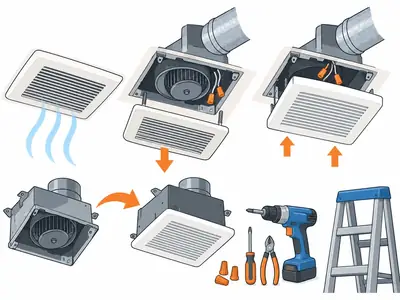 BathroomHow to Replace a Bathroom Exhaust FanLearn how to replace a bathroom exhaust fan from below. Measure the housing, turn off power, swap the old unit and seal the duct well.
 BathroomHow to Clean a Bathroom Exhaust Fan to Restore Its AirflowHow to clean a bathroom exhaust fan twice a year: wash the grille, vacuum the blower and housing, check the flap and test airflow, keeping water off the motor.