
How to Childproof Stairs and Banisters
Part of: Electrical safety
- Difficulty
- Easy
- Time
- 1 to 3 hours for a typical staircase
- Tools
- Tape measure, stud finder, drill, screwdriver, hardware-mounted gate, wall anchors or blocking, baluster guard or mesh, zip ties or brackets, level
- Call a pro if
- The railing itself is loose, the balusters are spaced wide and cannot be covered, or the stair has an open side with no rail. Those are structural fixes, not childproofing.
In this guide
Stairs are one of the most common places for a toddler injury, and most of the fixes are simple. Getting how to childproof stairs and banisters right depends on a 4 inch sphere and hardware that does not move. The two that matter are the gate at the top and the spacing between the balusters.
Here is how to childproof stairs and banisters, in the order that removes the biggest risks first.
1. Start with the gate at the top of the stairs
This is the single most important item. A gate at the top must be screwed into the wall or the newel post.
1. Choose a hardware-mounted gate rated for the top of a staircase.
2. Find the studs on both sides with a stud finder.
3. Mount the brackets into the studs, or into blocking you add behind the drywall.
4. Check the gate opens away from the stairs, never over them.
5. Pull hard on the closed gate to test it.
If one side of the opening is a newel post, the gate bracket can be strapped to it, but only if the post is solid. A wobbly post has to be fixed first.
2. Fit a gate at the bottom
The bottom gate is a convenience gate, and a pressure-mounted gate is acceptable there because a child who pushes it loose does not fall far.
Measure the opening, including baseboards, since a gate that fits a bare doorway will not fit over trim. Choose a gate with a walk-through door so adults are not stepping over it dozens of times a day.
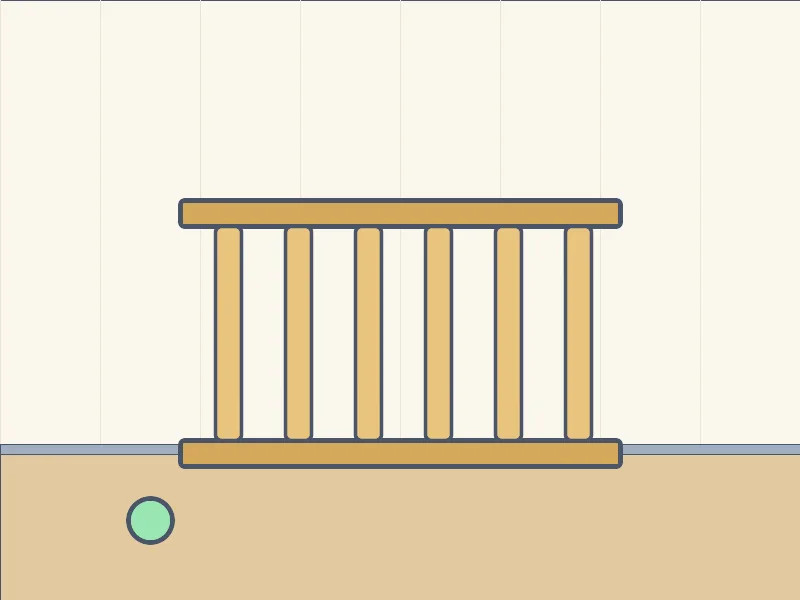
3. Check the baluster spacing
The standard rule is that a 4 inch sphere should not pass through any opening in a railing. That is roughly the size of a small child's head.
Measure between the balusters at the widest point. If the gap is larger than 4 inches, a child can slip through or get stuck.
Options for a wide-spaced rail:
- Add balusters so the spacing meets the rule.
- Fit a clear baluster guard, a rigid panel that closes the gaps.
- Use a tightly fixed mesh designed for this purpose, not a loose net.
Temporary fixes with tape or cardboard are not safe.
4. Look at the rail height
A handrail should be high enough that a child cannot easily climb over it. For a toddler, the practical goal is a rail they cannot vault, which usually means adding a second, higher rail or a solid guard panel on an open side.
If the stair is open on one side with no rail at all, that is a fall waiting to happen and needs a proper rail, not a gate.
5. Clear the stairs and the landing
Most stair falls at home are not from a missing gate. They are from something on the steps.
- Keep shoes, toys, laundry, and boxes off the treads.
- Move furniture away from the top landing so a child cannot climb it to the rail.
- Do not leave a laundry basket on the stairs "for later".
- Keep the stair light working, with a switch at both ends.
6. Fix loose or sharp parts
Walk the stairs and check:
1. Any loose baluster, which a child can pull free.
2. Any loose newel post, which can fail under a lean. Our guide on installing a baby gate covers the doorway version.
3. Sharp corners on tread edges or rail ends.
4. A handrail that ends without a return into the wall, which can catch clothing.
7. Cover the gaps at the bottom and top
A gap between the bottom rail and the floor, or between the gate and the wall, can trap a small limb. Check the gate's instructions for the maximum allowed gap and adjust the brackets.
Check also for a gap between the stair and an adjacent wall where a child could wedge.
8. Add a non-slip surface
Wood stairs get slick in socks. Adhesive non-slip strips on the tread edges help, especially on the bottom two steps where most slips happen.
Make sure the strips sit flat and do not curl at the edges.
9. Review it as the child grows
A gate that works for a crawling baby is a climbing frame for a two year old. Recheck the setup every few months:
- Is the gate still latched properly?
- Has the child learned to climb it?
- Is anything stacked near the rail?
Common mistakes
- A pressure-mounted gate at the top of the stairs.
- An accordion gate with openings a head can fit through.
- Relying on a loose newel post to hold a gate.
- Leaving objects on the steps.
- Ignoring baluster spacing because the rail "looks fine".
FAQ
What type of gate is safe at the top of stairs?
A hardware-mounted gate that screws into framing, rated for stair top use. Pressure gates are for the bottom or for doorways on flat floors.
How do I fix balusters that are too far apart?
Add balusters, fit a rigid baluster guard, or install a proper mesh panel fixed tight to the rail. Do not use a loose net.
At what age can I remove the stair gate?
When the child can safely use the stairs, usually around two to three years, and can open the gate themselves. Keep the rail and spacing rules in place regardless.
Are stair gates safe for pets too?
Most are, but check the bar spacing for a small pet, since a pet can get stuck in gaps meant for children.
Related guides
- How to Install a Baby Gate at the Top and Bottom of Stairs: Learn how to install a baby gate safely: choose pressure or hardware mounted, fit it at the right height,...
- How to Fix a Loose Baluster: How to fix a loose baluster: find out why it worked free, tighten or reset the joint, and make the railing...
- How to Make Stairs Less Slippery: How to make stairs less slippery: find the real cause, then add grip with treads, strips, finish changes, or...
- How to Childproof Cabinets and Drawers in the Kitchen: Childproof cabinets and drawers with the right latch for each door style, correct placement, and a plan for...
- How to Babyproof a Fireplace and Hearth: Learn how to babyproof a fireplace: gate it off, pad the hearth edges, secure the screen, and keep tools and...
 SafetyHow to Install a Baby Gate at the Top and Bottom of StairsLearn how to install a baby gate safely: choose pressure or hardware mounted, fit it at the right height, avoid the stair top trip hazard and test the latch.
 SafetyHow to Fix a Loose BalusterHow to fix a loose baluster: find out why it worked free, tighten or reset the joint, and make the railing solid again without replacing the whole run.
 SafetyHow to Make Stairs Less SlipperyHow to make stairs less slippery: find the real cause, then add grip with treads, strips, finish changes, or a runner, and keep the stairs safe.
 SafetyHow to Childproof Cabinets and Drawers in the KitchenChildproof cabinets and drawers with the right latch for each door style, correct placement, and a plan for the most dangerous cabinets first.First HomeHow to Babyproof a Fireplace and HearthLearn how to babyproof a fireplace: gate it off, pad the hearth edges, secure the screen, and keep tools and matches out of reach.