
How to Remove a Silicone Bead Cleanly
Part of: Basic plumbing

- Difficulty
- Easy
- Time
- 30 to 90 minutes
- Tools
- Silicone remover tool, sharp knife, plastic scraper, mineral spirits, cloth, silicone remover gel, gloves, vacuum
- Call a pro if
- The caulk is on a natural stone surface or a specialist finish, since solvent and scrapers can stain or scratch those.
In this guide
- Wear protection
- Chemical safety
Old silicone has to come off completely before new caulk will stick. Leftover slivers are why a fresh bead peels within weeks. How to remove a silicone bead cleanly starts with a sharp knife along both edges, top and bottom, before anything is pulled.
1. Cut both edges
1. Run a sharp knife along the top edge where the silicone meets the wall.
2. Run it along the bottom edge where it meets the tub or tray.
3. Keep the blade flat against the surface to avoid gouging.
4. Work in short sections.
5. Do not try to cut through the full thickness in one pass.
2. Peel the bead away
1. Pick up one end with a plastic scraper.
2. Pull steadily along the joint, at a low angle.
3. Most silicone comes away in one long strip if the edges are cut.
4. Work slowly near corners; that is where it tears.
5. Put the waste straight in the trash can.
3. Use a silicone remover tool
1. A shaped remover tool has a profile that follows the joint.
2. Push it along the joint to lift the remaining caulk.
3. Use the pointed end for corners.
4. Plastic tools are safer than metal on acrylic.
5. Keep the tool flat to the surface.
4. Soften the residue
1. Apply a silicone remover gel to the residue and leave it as the label says.
2. Alternatively, soften with mineral spirits on a cloth.
3. Scrape again with a plastic scraper.
4. Repeat rather than scrubbing hard.
5. Do not use a wire brush or abrasive pad.
5. Clean the joint
1. Vacuum out crumbs of silicone.
2. Wipe with mineral spirits and a clean cloth.
3. Change the cloth often; a dirty cloth spreads silicone.
4. Let the surface dry completely.
5. Check with a fingertip that no slippery film remains.
6. Deal with mold staining
1. Black staining on the surface can be cleaned, but staining in the joint means the caulk had to go.
2. Treat the area with a mold cleaner and rinse.
3. Let it dry fully.
4. If the mold is behind the seal, find the moisture source first.
7. Check the surfaces before resealing
- Silicone will not stick to damp, dusty or oily surfaces.
- Silicone will not stick to old silicone.
- Some plastics need a primer.
- Natural stone can be stained by solvent; test in a hidden spot.
8. Dispose of it properly
1. Silicone waste goes in general trash, not down the drain.
2. Wrap it so it does not stick to the trash can.
3. Clean tools with mineral spirits before the silicone sets.
4. Ventilate the room while solvent dries.
9. Make the next removal easier
- Apply a neat, thin bead; thick beads are harder to remove.
- Tool the bead once so it has clean edges to cut.
- Reseal before it goes black, when it still peels easily.
- Keep a silicone remover tool with the painting kit.
Common mistakes
- Pulling silicone off without cutting the edges.
- Using a metal blade on acrylic and scratching it.
- Leaving slivers behind and sealing over them.
- Resealing a wet joint.
- Using abrasive pads and dulling the surface.
FAQ
What is the easiest way to remove old silicone?
Cut both edges with a knife, peel it away, then soften the residue with a remover gel or mineral spirits.
Can I remove silicone with vinegar?
No. Vinegar does not dissolve silicone; it only helps with scale.
Do I have to remove all the old silicone?
Yes. New caulk will not bond to old silicone.
Can I use a knife on a plastic tub?
Use a plastic scraper or a remover tool instead, to avoid scratches.
Related guides
- Cracked Caulk Around a Sink: When to Redo It and How: Cracked caulk around a sink lets water seep under the counter. Learn how to cut it out, clean the gap and...
- How to Remove Hard Water Buildup from a Faucet: Learn how to remove hard water buildup from a faucet: soften deposits with vinegar or citric acid, clean the...
- How to Remove a Bathroom Vanity Without Flooding the Floor: Learn how to remove a bathroom vanity: shut off and cap the water, cut the sealant, disconnect the drain, and...
- How to Remove Mold from a Bathroom Ceiling: Learn how to remove mold from a bathroom ceiling safely: protect yourself, clean with the right product, seal...
- Shower Caulk Keeps Coming Off: Shower caulk keeps coming off? Learn why it peels, cracks or grows mold, from caulking a wet joint to the...
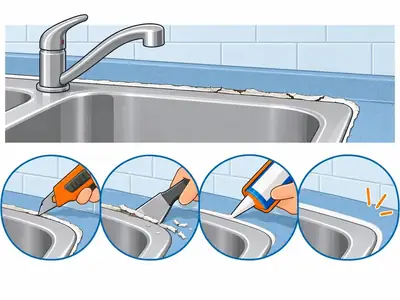 BathroomCracked Caulk Around a Sink: When to Redo It and HowCracked caulk around a sink lets water seep under the counter. Learn how to cut it out, clean the gap and apply a neat new bead that lasts for years.
 BathroomHow to Remove Hard Water Buildup from a FaucetLearn how to remove hard water buildup from a faucet: soften deposits with vinegar or citric acid, clean the aerator, polish the finish and stop it returning.
 BathroomHow to Remove a Bathroom Vanity Without Flooding the FloorLearn how to remove a bathroom vanity: shut off and cap the water, cut the sealant, disconnect the drain, and get the unit out without damaging tiles or walls.
 BathroomHow to Remove Mold from a Bathroom CeilingLearn how to remove mold from a bathroom ceiling safely: protect yourself, clean with the right product, seal and repaint, then fix the ventilation behind it.
 BathroomShower Caulk Keeps Coming OffShower caulk keeps coming off? Learn why it peels, cracks or grows mold, from caulking a wet joint to the wrong sealant, and how to make the next bead last.