
Sagging Closet Rod? How to Fix It and Hold More Weight
Part of: Floors, walls and doors
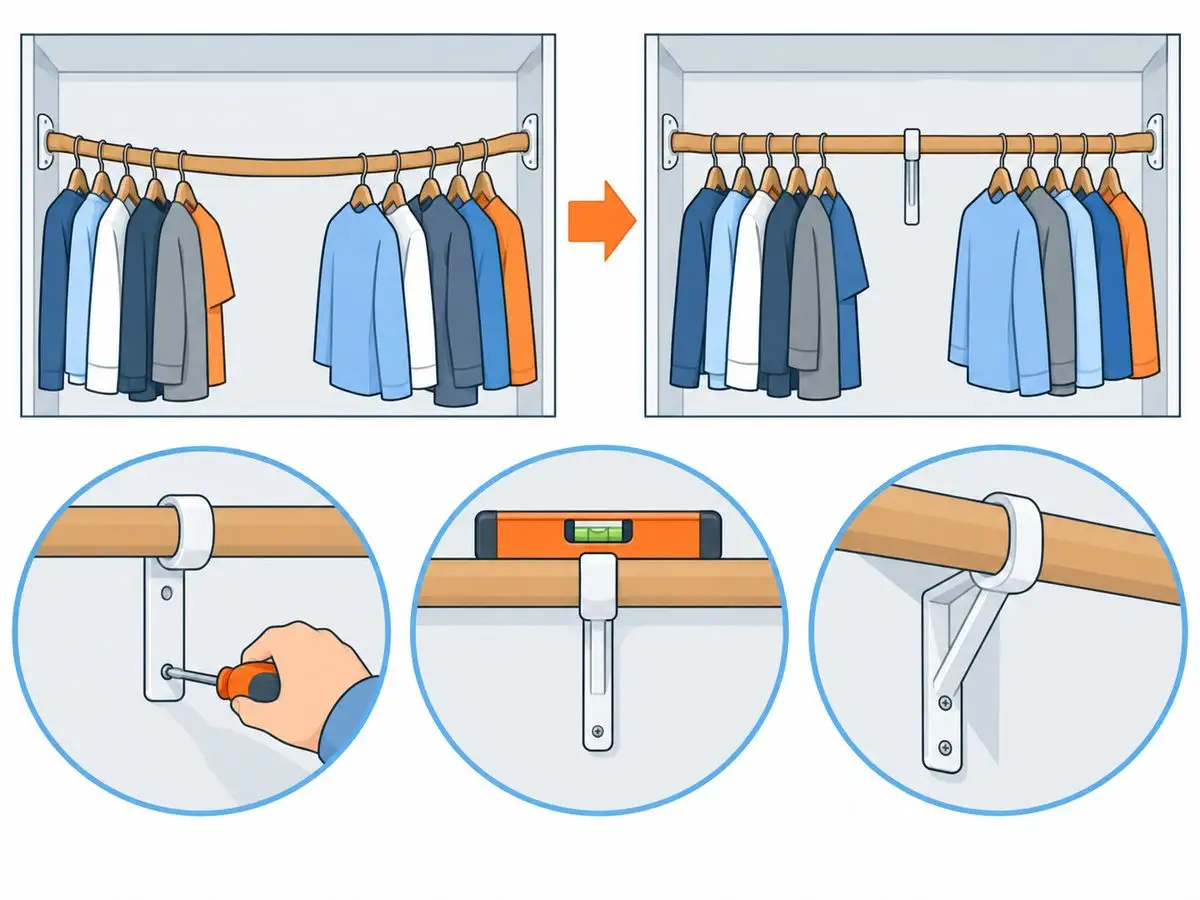
- Difficulty
- Easy to moderate
- Time
- 30 to 60 minutes
- Tools
- Drill, stud finder, level, screwdriver, tape measure, pencil, center support bracket, screws
- Call a pro if
- The wall is crumbling, the shelf is made of weak board that is broken, or you are unsure what the wall is made of.
In this guide
- Step 1: Empty the closet
- Step 2: Look at the brackets
- Step 3: Find the studs
- Step 4: Re-mount the end brackets
- Step 5: Add a center support
- Step 6: Check the shelf
- Step 7: Level and test
- Mistakes to avoid
- Keeping it from coming back
- Quick recap
- Choosing a stronger setup
- Related guides
- FAQ
- Before you reload the shelf
- When to call a pro
- Wear protection
A sagging closet rod usually means the load is too heavy for a long span or the brackets are loose in drywall. Adding a center support and fastening into studs fixes most cases.
This guide is part of our wider guide to drywall, paint and wall repair.
Step 1: Empty the closet
Take off clothes and boxes. This lets you see what is loose.
Step 2: Look at the brackets
Check the end brackets. If the screws are loose or pulling out of drywall, the wall anchors failed.
Step 3: Find the studs
Use a stud finder and mark the studs near the ends. Brackets screwed into studs hold much more.
Step 4: Re-mount the end brackets
Move or re-attach them with screws into the studs. If there is no stud, use heavy-duty wall anchors rated for the load.
Step 5: Add a center support
For spans over about 4 feet, add a center bracket. Screw it to the back wall into a stud, or to the top of the shelf and a ceiling joist, so it carries the rod from above or below.
Step 6: Check the shelf
If the shelf board bows, add a support strip under the front edge or turn the board over. Replace a cracked shelf.
Step 7: Level and test
Check the rod with a level and reload the clothes slowly. Spread heavy items out.
Mistakes to avoid
Do not rely on drywall anchors for heavy winter coats. Do not put all the weight on the center, since that is where a rod bends most. Do not drill without checking what is behind the wall. Also check that the rod does not slide out of its end brackets, because that is a common cause of a rod that seems to sag.
Keeping it from coming back
Spread heavy items near the supports, and use sturdy hangers. Keep boxes and bags off a thin shelf. If you often add more clothes, think about a second rod or a stronger shelf. Check the screws once a year, because wood moves with the seasons and screws can loosen.
Quick recap
The fix goes in a simple order: empty the closet, inspect the brackets, find the studs, re-mount the ends, add the center support and test with the clothes back on. If the wall crumbles around the screws or the shelf board itself is broken, replace the board or ask a carpenter to look at the wall.
Choosing a stronger setup
If the closet always sags under the same load, the setup may be too weak for how you use it. A thin wire shelf with a rod clipped under it holds far less than a solid wood shelf screwed to a cleat. A rod made of thin steel tube can bend over a long span. Look at upgrading to a thicker rod, or splitting a long closet into two shorter runs with a vertical divider in the middle. A vertical divider screwed into the studs and the shelf takes much of the weight. Measure first, since shelf boards come in standard lengths.
Related guides
- How to Add Shelves to a Closet (Simple DIY Shelving)
- How to Hang a Curtain Rod: Height, Width and Secure Mounting
- How to Install a Closet Rod That Holds a Full Rail of Clothes
- How to Organize a Small Closet: A Simple Plan That Holds Up
- How to Install a Closet Organizer Without Wasting the Space
FAQ
How much weight can a closet rod hold?
It depends on the rod, brackets and wall. Add a center support for long spans.
Should I use a metal rod?
A metal rod is stronger than a thin wood dowel for long spans.
Can I use plastic wall anchors?
Only for light items. Use studs for heavy loads.
Before you reload the shelf
Once the rod or shelf is firm, put the weight back in stages instead of all at once. Hang the heaviest coats near a bracket or a support, and keep folded stacks of heavy items on the floor of the closet or on a lower, well supported shelf. Look at the screws again after a week, since new fasteners can settle a little. If one starts to loosen again, move it to a fresh spot in the stud or switch to a longer screw. Check the closet once or twice a year as part of your normal home upkeep.
More from this topic
- How to Hang a Curtain Rod: Height, Width and Secure Mounting: Learn how to hang a curtain rod at the right height and width, find studs, choose anchors and keep a long rod...
- How to Hang a Shelf: Brackets, Anchors and Level Lines: How to hang a shelf that stays up: pick the right brackets, find studs or use proper anchors, and level it so...
- How to Install a Shelf on a Brick Wall: How to install a shelf on a brick wall: drill the brick, not the mortar, set masonry anchors, and get the...
- How to Remove a Built-In Shelf: Learn how to remove a built-in shelf from a wall or alcove, from finding the fixings to patching the wall it...
- How to Remove a Towel Bar From a Wall: Learn how to remove a towel bar from a wall, find the hidden set screws, lift the brackets and repair the...
 Walls and PaintHow to Hang a Curtain Rod: Height, Width and Secure MountingLearn how to hang a curtain rod at the right height and width, find studs, choose anchors and keep a long rod from sagging in the middle.
 Walls and PaintHow to Hang a Shelf: Brackets, Anchors and Level LinesHow to hang a shelf that stays up: pick the right brackets, find studs or use proper anchors, and level it so it stays level.
 Walls and PaintHow to Install a Shelf on a Brick WallHow to install a shelf on a brick wall: drill the brick, not the mortar, set masonry anchors, and get the brackets level and tight.
 Walls and PaintHow to Remove a Built-In ShelfLearn how to remove a built-in shelf from a wall or alcove, from finding the fixings to patching the wall it leaves behind.
 Walls and PaintHow to Remove a Towel Bar From a WallLearn how to remove a towel bar from a wall, find the hidden set screws, lift the brackets and repair the anchor holes cleanly.