
How to Fix a Vanity Light
Part of: Basic plumbing
- Difficulty
- Moderate
- Time
- 30 minutes to 2 hours
- Tools
- Screwdriver set, voltage tester, multimeter, wire strippers, new bulbs of the right type, wire nuts, electrical tape, a replacement fixture or socket if needed, stepladder, work gloves
- Call a pro if
- You find scorched wires, a burning smell, a fixture that is hot to the touch, or wiring that is not what you expected behind the wall, or you are not confident working at the breaker panel.
In this guide
- Power off first
A bathroom vanity light works hard in a damp room, and when it stops working the cause is usually simple: a dead bulb, a loose connection, a failed socket or a switch that has worn out. Flickering and dimming have their own short list of causes. Working through them in order saves you from replacing a fixture that only needed a new socket. Here is how to fix a vanity light, from the easy checks to the ones that involve a screwdriver.
This guide is part of our wider guide to bathroom fixtures, tile and grout.
1. Start with the bulbs
Change every bulb in the fixture, not just the one that looks dead. A vanity bar often has three or four bulbs on one circuit, and one failed bulb can make the rest look dim or flicker if the fixture is wired in a way that shares the load oddly.
Check the bulb type and wattage against the label inside the fixture. A bulb with a higher wattage than the fixture allows overheats the socket and shortens its life. If the fixture takes halogen or incandescent bulbs, LED replacements of equivalent brightness run far cooler and last longer.
2. Test whether the problem is the fixture or the power
If new bulbs do not fix it, you need to know whether power is reaching the fixture. Checking for power at the fixture means testing live wires, which we do not recommend for a beginner. If new bulbs do not help, keep the breaker off and move on to the switch and socket checks below, or call an electrician to test the circuit.
If there is no power at the fixture, the problem is upstream: the switch, the breaker or the wiring. If there is power at the fixture but the bulbs do not light, the problem is in the fixture.
3. Check the switch
A worn switch is a common cause of a light that works intermittently or needs a jiggle. With the breaker off and the wires confirmed dead with a voltage tester, remove the switch plate and switch, and look for loose wires or discolored terminals. Test the switch with a multimeter on continuity while toggling it. A switch that does not close the circuit reliably is a cheap replacement and a good place to spend ten minutes.
If the vanity light shares a plate with a fan or an outlet that still works, the switch itself is the likely culprit rather than the circuit.
4. Look at the sockets
With the power off, examine each socket. Look for a dark or scorched center contact, a cracked shell or a spring contact that has flattened. A socket that has overheated usually shows brown staining around the bulb base.
On many fixtures the socket is a small replaceable part held by a nut at the back. Take the old one to the store or match the base type and thread size. If the socket is riveted into the fixture, replacement means a new fixture.
5. Tighten and remake the connections
Loose wire nuts and back-stabbed connections are a frequent cause of flickering and dead lights in bathrooms, where humidity and vibration work connections loose. With the power off, check that each wire nut is tight and that no copper is exposed outside it. Remake any connection that looks loose, using a proper twist and a wire nut of the right size.
If the fixture uses push-in connectors, consider replacing them with wire nuts and a short pigtail, which hold better over time.
6. Deal with flicker properly
Flicker has a short list of causes:
- Loose bulb in the socket, which is the most common and the easiest to fix.
- LED bulbs on a dimmer that is not LED compatible, or too few bulbs for the dimmer's minimum load.
- A failing driver inside an integrated LED fixture, which usually means a new fixture.
- A loose neutral at the fixture or the switch, which needs an electrician if it is in the wall.
- Voltage drop from a shared circuit with a heavy load, such as a hair dryer on the same line.
Try the same bulbs in a different fixture to rule them out. Cheap LED bulbs flicker more than good ones, especially in a cold bathroom.
7. Replace the fixture if that is the answer
If the sockets are fine and power reaches the fixture but it still will not light, the fixture has failed internally. A new vanity bar is often cheaper than repairing an old one, and modern fixtures use far less power.
Turn off the breaker, confirm dead with a tester, disconnect the wires and remove the old fixture. Fit the new one to the existing box, connect black to black, white to white and ground to ground, and secure it. If the box is not rated for the weight of the new fixture, add a proper brace; a heavy vanity light pulling out of drywall is a real hazard.
8. Keep the bathroom lighting working
- Run the exhaust fan during and after showers; damp air corrodes sockets and connections. Our guide on replacing a bathroom exhaust fan covers a fan that has stopped pulling air.
- Wipe the fixture and bulbs occasionally; bathroom dust plus humidity forms a film that traps heat.
- Use bulbs rated for damp locations in a bathroom.
- If the mirror fogs constantly, that humidity is also reaching the fixture.
Common mistakes
- Changing one bulb when the fixture has several and assuming the rest are fine.
- Fitting a higher wattage bulb than the fixture label allows.
- Working on the fixture with only the wall switch off, when the circuit is still live at the box.
- Ignoring a scorched socket and fitting new bulbs into it.
- Hanging a heavy new fixture on the old, lightly fixed box.
Related guides
- How to Paint a Bathroom Vanity So It Survives the Steam
- How to Fix a Bathroom Mirror Cabinet That Will Not Close or Hangs Crooked
- How to Install a Bidet Seat on Your Toilet Step by Step
- How to Remove a Bathroom Vanity Without Flooding the Floor
FAQ
Why did my vanity light stop working suddenly?
Usually a bulb, a loose connection or a failed switch. If the outlet in the same bathroom still works, the problem is in the fixture or the switch rather than the circuit.
Can I replace a vanity light myself?
Yes, if you are comfortable turning off the breaker and connecting three wires. The job is straightforward, but if the wiring in the box is old, aluminum or unclear, use an electrician. Our guide on replacing a light fixture walks through the swap.
Why does my new LED bulb flicker in the bathroom?
Often a dimmer that is not LED compatible, a loose bulb, or a bulb that does not like cold, damp air. Try a different bulb of a known brand before assuming the fixture is faulty.
Do bathroom lights need special bulbs?
Use bulbs rated for damp locations and stay within the fixture's wattage. In a steamy bathroom, a bulb that runs cooler lasts longer.
More from this topic
- Bathroom Fan Not Working or Very Loud?: Bathroom fan not working or very loud? Try these safe checks: clean the cover, tighten the housing, check the...
- How to Replace an Outdoor Light Fixture: How to replace an outdoor light fixture: turn off power, test, swap the old fixture and seal against water....
- How to Install a Bathroom Vanity (Replacement Guide): Install a bathroom vanity by removing the old cabinet, setting and leveling the new one, anchoring it to...
- How to Install a Bathroom Vanity Top and Sink: Install a bathroom vanity top: measure the cabinet, pick the sink type, cut the opening, bed and seal the...
- How to Level a Bathroom Vanity on an Uneven Floor: Level a bathroom vanity on an uneven floor using tapered shims, a scribed filler strip for wall gaps, and...
 BathroomBathroom Fan Not Working or Very Loud?Bathroom fan not working or very loud? Try these safe checks: clean the cover, tighten the housing, check the switch and know when to replace the fan.
 Electrical BasicsHow to Replace an Outdoor Light FixtureHow to replace an outdoor light fixture: turn off power, test, swap the old fixture and seal against water. Steps, tools and when to call an electrician.
 BathroomHow to Install a Bathroom Vanity (Replacement Guide)Install a bathroom vanity by removing the old cabinet, setting and leveling the new one, anchoring it to studs, and reconnecting the drain and supply lines.
 BathroomHow to Install a Bathroom Vanity Top and SinkInstall a bathroom vanity top: measure the cabinet, pick the sink type, cut the opening, bed and seal the top, fit splashes, keep plumbing reachable.
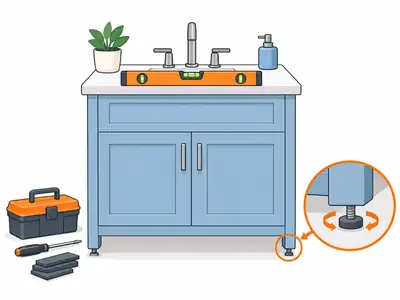 BathroomHow to Level a Bathroom Vanity on an Uneven FloorLevel a bathroom vanity on an uneven floor using tapered shims, a scribed filler strip for wall gaps, and fresh caulk along the backsplash.