
How to Store Lumber
Part of: Tools and everyday fixes
- Difficulty
- Easy
- Time
- 30 to 60 minutes
- Tools
- stickers or scrap strips, sawhorses or rack, tape measure, marker, tarp or cover, moisture meter if available, gloves
- Call a pro if
- The lumber is structural and has been wet or warped for a long time, since it may no longer be fit for load bearing use.
In this guide
- Wear protection
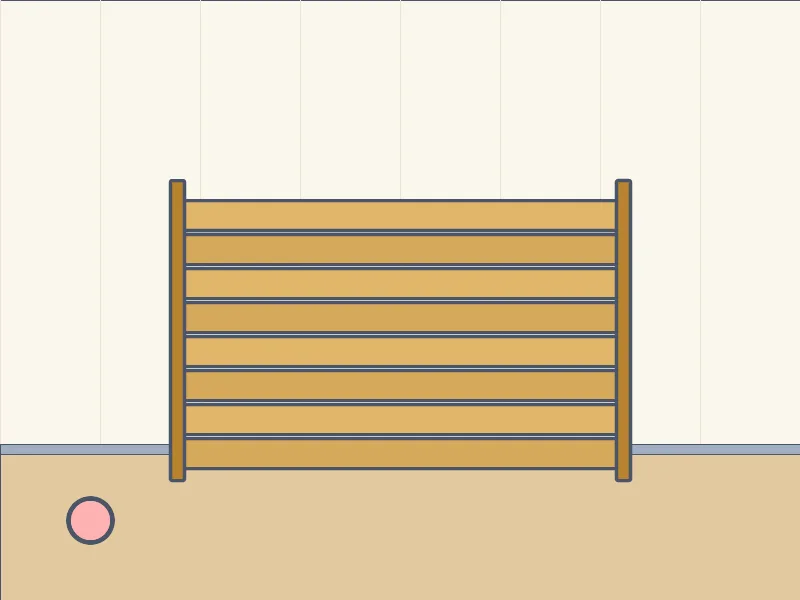
Knowing how to store lumber keeps material usable for the next project. A board that was straight at the store can bow in a week if it is leaned against a wall or laid flat on a damp floor.
The principle is simple: support the board along its length, let air reach all faces, and keep moisture away. Everything else is a version of that.
1. Decide what is worth keeping
Sort the lumber before you store it. Short offcuts, split boards, and pieces with rot take up space that better material needs. Keep what you will realistically use, and cut the rest down for scrap or dispose of it.
2. Choose a dry spot
A garage, basement, or shed works if it stays dry. Lumber in a damp basement absorbs moisture and can grow mold. Lumber in a hot attic dries too fast and checks. A dry, shaded spot with some air movement is best.
3. Get it off the floor
Lay two or three bearers on the floor and set the stack on them. This lifts the lumber off concrete, which wicks moisture, and lets air move under the bottom layer. pressure-treated scraps make good bearers.
4. Stack flat and level
Lay the boards flat, edge to edge, on a level base. A stack that sits on an uneven floor takes a twist that the boards keep. Use a level on the bearers before you load them, and shim if needed.
5. Add stickers between layers
Put thin strips, called stickers, across each layer at about 16 to 24 inches apart, then start the next layer. Stickers let air circulate between the boards so they dry evenly. Use dry scrap strips about three quarters of an inch thick.
6. Align the stickers
Line up the stickers directly above one another from layer to layer. Misaligned stickers put a bending force on the boards and cause bowing. Keep the stack square and the ends flush so the weight is even.
7. Keep the ends supported
Support the ends of long boards, not just the middle. A board supported only in the center sags at the ends over time. If the stack is longer than your rack, use a third bearer in the middle.
8. Cover the top, not the sides
Lay a board or a sheet of plywood on top of the stack to shed dust and drips, and leave the sides open. A tarp wrapped around the whole stack traps moisture and causes mold. If you must use a tarp, keep it off the wood with a frame.
9. Label and organize by size
Mark the ends of boards with a pencil so you know the species and length at a glance, and store the longest boards at the bottom or in a separate rack. Sorting by length saves time on the next project.
10. Check it now and then
Look at the stack every few months. Any board that has started to bow should be moved or used. If the wood feels damp, find out why, since a wet stack will not dry in a closed space.
Common mistakes
- Leaning boards against a wall, which bows them.
- Stacking directly on a concrete floor, which wicks moisture.
- Wrapping the whole stack in a tarp, which traps damp.
- Skipping stickers, so the inner boards never dry.
- Storing in a damp basement without air movement.
- Keeping every offcut, so the stack becomes a pile.
FAQ
How should lumber be stored to keep it straight?
Flat, level, off the floor, with stickers between layers and support under the ends.
Does lumber need to be stored off concrete?
Yes. Concrete wicks moisture into the wood, which can cause warping and mold.
Can I store lumber outside?
Short term, with the top covered and the sides open, on bearers. Long term, it belongs in a dry space.
How long can lumber be stored?
Years, if it is dry, flat, and ventilated. Check it periodically for warp and pests.
Should I cover a lumber stack with a tarp?
Only the top, to shed water. Wrapping the sides traps moisture.
Related guides
- How to Store Power Tools: How to store power tools so batteries and blades last: keep them dry, off the floor, labeled, and out of...
- How to Store Leftover Paint: How to store leftover paint so it stays usable: seal the can, label the room, keep it from freezing, and know...
- How to Store Leftover Tile: How to store leftover tile so it matches later: keep a full box, label the room, store it flat and dry, and...
- How to Choose and Wear a Dust Mask: Learn how to choose and wear a dust mask: match the rating to the dust, fit it with a seal check and replace...
- How to Use a Jigsaw for Curves and Cutouts: Learn how to use a jigsaw: pick the right blade, set the speed and orbital action, support the work, cut...
 Tools and BasicsHow to Store Power ToolsHow to store power tools so batteries and blades last: keep them dry, off the floor, labeled, and out of freezing temperatures.
 Tools and BasicsHow to Store Leftover PaintHow to store leftover paint so it stays usable: seal the can, label the room, keep it from freezing, and know when to dispose of it.
 Tools and BasicsHow to Store Leftover TileHow to store leftover tile so it matches later: keep a full box, label the room, store it flat and dry, and know how much to keep.
 Tools and BasicsHow to Choose and Wear a Dust MaskLearn how to choose and wear a dust mask: match the rating to the dust, fit it with a seal check and replace it when it loads up.
 Tools and BasicsHow to Use a Jigsaw for Curves and CutoutsLearn how to use a jigsaw: pick the right blade, set the speed and orbital action, support the work, cut curves slowly and keep the base flat.