
How to Test Garage Door Auto-Reverse in Minutes
Part of: Outdoors and garage
- Difficulty
- Easy
- Time
- About five minutes a month
- Tools
- A roll of paper towels or a 2x4 board, and a step stool if your sensors are hard to reach
- Call a pro if
- The door fails either test even after cleaning and realigning the sensors, or the door has no photo-eye sensors at all.
In this guide
Every garage door opener sold in the United States since the early 1990s has two safety systems: photo-eye sensors that stop the door when something breaks the beam, and a pressure reverse that backs the door off when it meets resistance. Both need a monthly test. Here is how to test garage door auto-reverse the right way.
1. Find the two safety systems
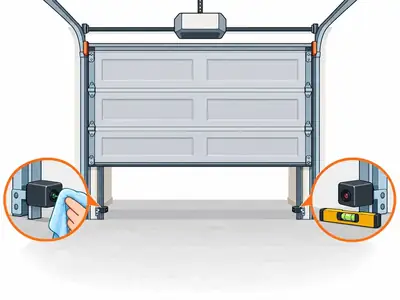
1. Look for the photo-eye sensors on the vertical tracks, a few inches above the floor.
2. Each sensor has a small lens; one sends the beam and one receives it.
3. Most have small indicator lights that glow when the beam is aligned.
4. The pressure reverse is built into the opener motor itself, not a part you can see.
2. Run the sensor test
1. With the door fully open, press the wall button or remote to close it.
2. As the door comes down, wave a broom or your foot through the beam, without standing in the door's path.
3. The door should stop and reverse to fully open immediately.
4. If the door keeps closing, the sensors are dirty, misaligned, wired wrong or failed; fix it before using the door again.
3. Run the pressure test
1. Lay a 2x4 board flat on the floor where the door meets the ground.
2. Close the door with the wall button.
3. When the door touches the board, it should stop and reverse within about two seconds.
4. If the door pushes down on the board or strains against it, the down-force setting is too high and needs adjustment or professional service.
4. Clean and align the sensors
1. Wipe both lenses with a soft dry cloth; dust and spider webs block the beam.
2. Check that both indicator lights are steady, not flickering.
3. If one light is off or blinking, loosen the wing nut and gently aim the sensor at its partner until the light steadies.
4. Check the sensor wires for damage where they run up the wall.
5. Adjust the down-force setting if needed
1. Look for the down-force adjustment screws on the opener motor unit, usually marked with arrows.
2. If the door failed the pressure test, turn the down-force screw slightly toward less force, following the opener manual.
3. Retest with the board after each small adjustment.
4. If the door still will not reverse off the board after adjustment, stop and call a pro.
6. Test the balance too
1. Pull the red release cord with the door closed to disconnect the opener.
2. Lift the door by hand to about waist height and let go.
3. A balanced door stays in place; a door that slams down or shoots up has a spring problem.
4. Springs are under extreme tension; a balance problem is always a pro job.
7. Know when to call a pro
- The door fails the sensor test after cleaning and alignment.
- The door fails the pressure test and adjusting the down-force screw does not fix it.
- The door is unbalanced or a spring, cable or roller looks worn or broken.
- The opener has no photo-eye sensors, which means it predates the safety standard and should be replaced.
Common mistakes
- Testing the sensors by blocking one with your hand while standing in the doorway, which puts you in the door's path if it fails.
- Skipping the pressure test because the sensors work; the two systems back each other up and both need testing.
- Taping over or removing misaligned sensors instead of fixing the alignment, which leaves the door with no beam protection.
- Testing once and forgetting it; vibration loosens sensor brackets over time, so monthly testing matters.
FAQ
How often should I test garage door auto-reverse?
Once a month for both tests. It takes five minutes and catches sensor drift and force problems before they become dangerous.
Why does my door reverse before it touches the floor?
Something is tricking the pressure reverse: a dirty track, a binding roller, or a down-force setting that is too sensitive. Clean and lubricate the tracks and rollers first, then retest.
Can I test the sensors with my phone flashlight?
No. The sensors use an infrared beam between the two units. The test that matters is breaking that beam while the door closes, from outside the door's path.
My door reverses at random. What is wrong?
Usually misaligned or dirty sensors, or sunlight hitting the receiving sensor and washing out the beam. Clean the lenses, check alignment, and shade the sensor if sun hits it at certain hours.
Related guides
- How to Test Garage Door Balance in a Few Minutes: Learn how to test garage door balance safely: disconnect the opener, lift the door by hand, read what it...
- Garage Door Won't Close Unless You Hold the Button: Garage door won't close unless you hold the button? Learn what the safety sensors are telling you and how to...
- How to Use a Pressure Washer Safely on Any Surface: Learn how to use a pressure washer safely: pick the right nozzle and pressure, keep the right distance, and...
- Painting Vinyl Siding: A Step-by-Step Guide: Painting vinyl siding works if you clean it, stay no darker than the original color, and use the right...
- Garage Door Won't Close All the Way? 5 Fixes: Garage door won't close all the way? Check the safety sensors, the track and the close limit setting with...
 Garage and OutdoorsHow to Test Garage Door Balance in a Few MinutesLearn how to test garage door balance safely: disconnect the opener, lift the door by hand, read what it tells you and know when to call a technician.
 Garage and OutdoorsGarage Door Won't Close Unless You Hold the ButtonGarage door won't close unless you hold the button? Learn what the safety sensors are telling you and how to fix it without disabling the beam.
 Garage and OutdoorsHow to Use a Pressure Washer Safely on Any SurfaceLearn how to use a pressure washer safely: pick the right nozzle and pressure, keep the right distance, and avoid the mistakes that damage.
 Garage and OutdoorsPainting Vinyl Siding: A Step-by-Step GuidePainting vinyl siding works if you clean it, stay no darker than the original color, and use the right acrylic paint. Full steps here.
 Garage and OutdoorsGarage Door Won't Close All the Way? 5 FixesGarage door won't close all the way? Check the safety sensors, the track and the close limit setting with these safe steps, and learn when to call a pro.