
How to Add an Outlet to a Bathroom
Part of: Electrical safety
- Difficulty
- Hard
- Time
- 3 to 6 hours
- Tools
- Old work electrical box, GFCI receptacle, 12 or 14 gauge cable, cable clamps, wire strippers, voltage tester, drill, drywall saw, fish tape, screwdrivers, wire nuts, caulk, gloves, eye protection
- Call a pro if
- The panel is full, the circuit cannot take the load, or you are not certain how to make a safe splice. A bathroom outlet is not a learning project.
In this guide
- Power off first
Bathrooms never have enough outlets. One by the mirror, one behind the door, and suddenly a hair dryer is running off an extension cord across a wet floor. Adding a receptacle is a real electrical job with a clear sequence, and half of it is deciding whether you should be the one doing it. Here is how to add an outlet to a bathroom.
1. Decide if the circuit can take it
1. A hair dryer alone can draw 1500 watts.
2. Bathroom circuits are often shared with other rooms.
2. Find a source
1. The best source is an existing bathroom circuit.
2. A nearby bedroom circuit may not be allowed to feed a bathroom.
3. Choose the location
1. Within reach of the mirror, not over the sink rim.
2. Outside the tub and shower zone: no receptacle within 3 ft horizontally or 8 ft vertically of the tub rim or shower threshold (NEC 406.9(C)). A cover plate does not change it. If the only reachable spot is inside that zone, put the outlet somewhere else. A receptacle beside the sink is a separate rule: it must be within 3 ft of the basin edge (NEC 210.52(D)).
4. Plan the cable run
1. Shorter is easier and safer.
2. Through the wall cavity, not through a duct.
5. Kill the power and prove it
1. Breaker off, tester on every wire.
2. Label the breaker while you are there.
6. Cut the opening
1. Trace the box, cut slightly small.
2. A drywall saw keeps the cut clean.
7. Set an old work box
1. The tabs clamp to the back of the drywall.
2. A box with a cable clamp holds the wire tight.
8. Fish the cable
1. Fish tape through the cavity.
2. Leave a foot of slack at each end.
9. Splice at the source
1. Same gauge wire, proper connectors.
2. A junction box must stay accessible.
10. Fit a GFCI receptacle
1. Bathroom outlets need ground fault protection.
2. Line and load terminals are not interchangeable.
11. Ground it properly
1. Bare copper to the green screw.
2. No ground means no protection.
12. Test before the wall goes back
1. Power on, tester in the slots.
2. Press test, then reset.
13. Finish and seal
1. Cover plate snug, caulk the top edge in a wet zone.
2. No gaps for steam to reach the box.
Common mistakes
- Using a non GFCI outlet in a bathroom.
- Mixing wire gauges in one circuit.
- Leaving a junction buried in a wall.
- Cutting the opening too large.
- Working live because the breaker was not labeled.
When to call a pro
Adding a receptacle is new wiring, not a swap, and it is the line where most homeowners should stop. Bathroom outlets need GFCI protection and the bathroom circuit has its own code rules, and new cable runs are permit and inspection work in most jurisdictions. Hire a licensed electrician; the job is quick for a pro and the inspection protects you at sale time. Sources: NFPA 70 (NEC) 210.8 and 210.11(C), local permit rules.
FAQ
Does a bathroom outlet have to be GFCI?
Yes. Every bathroom receptacle needs ground fault protection.
Can I run a bathroom outlet off a bedroom circuit?
Usually no. Bathrooms need their own circuit or a circuit that serves only the bathroom.
How high should the outlet be?
Around 40 inches, above the counter and within reach of the mirror.
Can I do this myself?
The planning and the patching, yes. The wiring only if you are confident and it is legal where you live.
Related guides
- GFCI vs AFCI: What Is the Difference?: GFCI vs AFCI: learn what each protects against, where they are used and how to test them. A clear guide for...
- DIY Electrical Work: What Is Safe for a Homeowner: DIY electrical work, sorted: what a careful homeowner can do safely, what needs a licensed electrician, and...
- What to Do When Your GFCI Outlet Will Not Reset: Learn what to do when your GFCI outlet will not reset: check for a tripped breaker, unplug devices, find...
- How to Replace a GFCI Outlet Safely (Installation Steps): Learn how to replace a GFCI outlet. Turn off the power, identify line and load wires, connect the new outlet...
- How to Replace an Outlet: Swap a GFCI Outlet Safely: Learn how to replace an outlet with a GFCI outlet safely: turn off power at the breaker, test it, swap the...
 Electrical BasicsGFCI vs AFCI: What Is the Difference?GFCI vs AFCI: learn what each protects against, where they are used and how to test them. A clear guide for first-time homeowners.Electrical BasicsDIY Electrical Work: What Is Safe for a HomeownerDIY electrical work, sorted: what a careful homeowner can do safely, what needs a licensed electrician, and the breaker-off test-everything routine.
 Electrical BasicsWhat to Do When Your GFCI Outlet Will Not ResetLearn what to do when your GFCI outlet will not reset: check for a tripped breaker, unplug devices, find linked outlets and know when to replace it.
 Electrical BasicsHow to Replace a GFCI Outlet Safely (Installation Steps)Learn how to replace a GFCI outlet. Turn off the power, identify line and load wires, connect the new outlet and test it with the test and reset buttons.
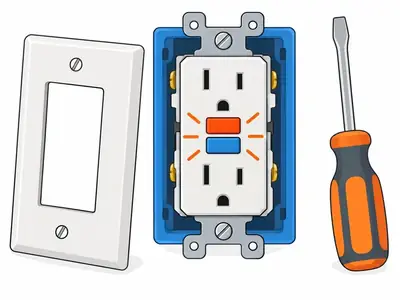 Electrical BasicsHow to Replace an Outlet: Swap a GFCI Outlet SafelyLearn how to replace an outlet with a GFCI outlet safely: turn off power at the breaker, test it, swap the wires and when to call an electrician.