
How to Replace a GFCI Outlet Safely (Installation Steps)
Part of: Electrical safety
- Difficulty
- Medium
- Time
- 30 to 60 minutes
- Tools
- Non-contact voltage tester, screwdrivers, wire stripper, needle nose pliers, masking tape, pen, replacement GFCI
- Call a pro if
- the wiring is aluminum, scorched or brittle, the box has more than the expected wires or you cannot tell line from load
In this guide
- Power off first
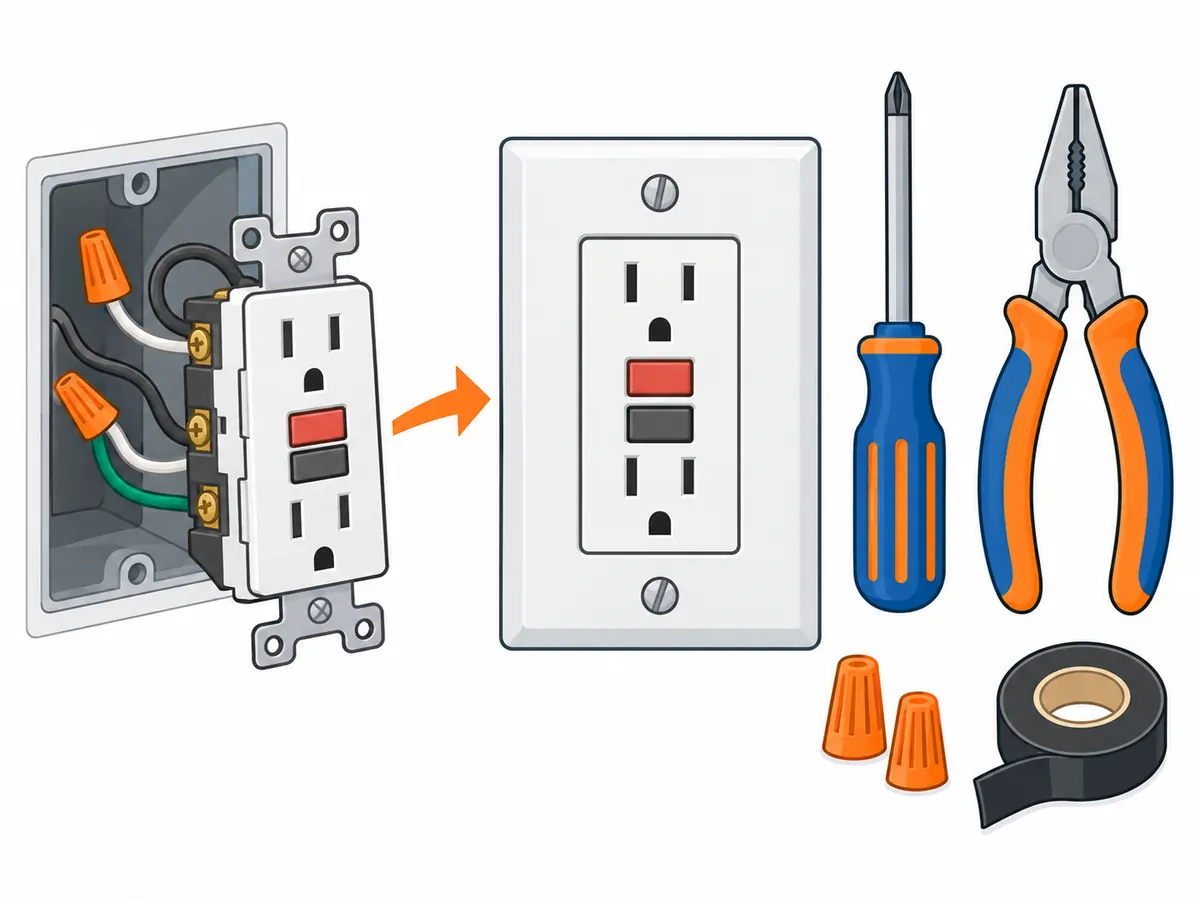
A GFCI outlet protects you from shock by cutting power when it senses a leak of current. It is required in kitchens, bathrooms, garages and outdoors. Over time it can wear out. If yours will not reset or trips often, you may need to replace a GFCI outlet. The key is to get the line and load wires right.
This guide is part of our wider guide to electrical problems and safety.
First, check if it needs replacing
See GFCI outlet will not reset for checks. A GFCI that is old, will not reset, has no power or fails the test button is usually worn out. Also check for moisture or a faulty device on the circuit before you replace it.
What are line and load?
- Line wires bring power from the panel to the outlet.
- Load wires carry protected power from the GFCI to other outlets downstream.
The GFCI has two sets of screws. A set marked LINE is on one side, and a set marked LOAD is on the other. Connecting them the wrong way can leave the GFCI not working or protect nothing. If only one cable enters the box, you will use only the line screws.
Step by step: replace the outlet
1. Turn off the breaker for the circuit. Check at the outlet with the voltage tester. Test every wire. See How to find your electrical panel and label breakers.
2. Remove the cover plate and the screws that hold the outlet.
3. Pull the outlet out and test again, with the tester close to each wire.
4. Take a photo of the wires.
5. Identify the line wires. If there are two cables in the box, one is line and one is load. On the old GFCI, the wires on the screws marked LINE are the line wires, and the ones on LOAD are the load wires. Use your photo. If the old outlet has no markings, or the wiring is not clear, stop and call an electrician. Do not turn the power on with loose wires to find out.
6. Label the wires with tape: line or load.
7. Disconnect the wires from the old outlet.
8. Connect the line wires to the LINE screws on the new GFCI. Black goes to the brass screw and white to the silver screw. Wrap each wire clockwise around the screw, then tighten.
9. Connect the load wires, if any, to the LOAD screws the same way.
10. Connect the ground wire to the green screw.
11. Fold the wires into the box and mount the outlet.
12. Attach the cover plate.
13. Turn on the power and press the RESET button. Press TEST. The power should go off and the reset button should pop out. Press RESET again.
14. Test with a plug-in tester or a lamp.
Signs that point to each cause
If the new GFCI trips right away, there may be a ground fault on the load side, in a downstream outlet or a device. If the GFCI has no power, a line wire is loose or the line and load are swapped. If other outlets do not work, the load wires may be wrong. If the GFCI hums or is warm, there may be a loose wire. If the breaker trips, there may be a short. Call an electrician if you cannot find the cause.
Which GFCI to buy
Match the amperage of the circuit, usually 15 or 20 amps. Choose a model rated for the location. For outdoors and wet locations, use a weather-resistant type. Many are also tamper-resistant. See Tamper-resistant outlets: what they are. Check that the unit has a self-test feature.
Prevention
Test GFCI outlets monthly with the test button. Replace them every ten years or when they fail. Keep outlets dry. Do not plug heavy loads into a GFCI circuit that trips. See GFCI vs AFCI: what is the difference.
Common mistakes to avoid
Do not reverse the line and load wires. Do not leave bare copper outside the screw. Do not clamp a wire under the screw head if it is nicked. Do not pinch a wire between the outlet and the box. Do not forget the ground wire. Do not skip the test and reset buttons after the install. If something seems different from this guide, such as extra wires or different colors, stop and ask an electrician.
Where GFCI protection is needed
Codes in many areas call for GFCI protection in bathrooms, kitchens near the sink, garages, basements, laundry areas, outdoors and near pools. Rules change over time and vary by location, so check with your local building department. A GFCI can also protect other outlets on the same circuit, so one GFCI at the start may cover several outlets downstream.
Related guides
- How to Test a GFCI Outlet in Under a Minute
- How to Install a USB Outlet to Replace a Standard Outlet
- How to Install a Smart Switch: Neutral Wire, Wiring and Setup
- Outlet Not Working in One Room: How to Fix It
- How to Replace a Light Fixture Safely
- EV Charger Installation at Home: What It Involves
- How to Protect Electronics From Power Surges
When to call a pro
Swapping a GFCI on an existing circuit is reasonable DIY with the breaker off and a tester. Call a licensed electrician if the new GFCI will not reset after correct line and load wiring, if the box holds aluminum or knob-and-tube wiring, or if the same circuit keeps tripping afterward, since a tripping GFCI is often reporting a real fault downstream. Sources: NFPA 70 (NEC) 210.8, manufacturer line/load instructions.
FAQ
Can I replace a GFCI with a regular outlet?
Not where the code requires GFCI protection.
Why does my GFCI keep tripping?
Moisture, a faulty device or a worn GFCI may be the cause.
What if I only have two wires?
Then it is probably one cable and you use only the line terminals.
Do GFCI outlets wear out?
Yes, they can fail after years of use.
More from this topic
- GFCI Keeps Tripping: What It Means and What to Do: When a GFCI keeps tripping, it is doing its job: a ground fault, a wet location, a bad appliance or a failing...
- How to Replace a Two-Prong Outlet Safely: Learn how to replace a two-prong outlet safely, what your options are when there is no ground wire and when...
- How to Test a GFCI Outlet in Under a Minute: Learn how to test a GFCI outlet: use the test and reset buttons, check it with a plug-in tester, and know...
- How to Replace an Outlet: Swap a GFCI Outlet Safely: Learn how to replace an outlet with a GFCI outlet safely: turn off power at the breaker, test it, swap the...
- How to Add an Outlet to a Bathroom: Learn how to add an outlet to a bathroom with GFCI protection, a proper box and the wiring steps, plus the...
 Electrical BasicsHow to Replace a Two-Prong Outlet SafelyLearn how to replace a two-prong outlet safely, what your options are when there is no ground wire and when to call an electrician. Step by step guide.Electrical BasicsHow to Test a GFCI Outlet in Under a MinuteLearn how to test a GFCI outlet: use the test and reset buttons, check it with a plug-in tester, and know when the outlet needs replacing.
 Electrical BasicsHow to Replace an Outlet: Swap a GFCI Outlet SafelyLearn how to replace an outlet with a GFCI outlet safely: turn off power at the breaker, test it, swap the wires and when to call an electrician.
 Electrical BasicsHow to Add an Outlet to a BathroomLearn how to add an outlet to a bathroom with GFCI protection, a proper box and the wiring steps, plus the parts a homeowner should not do alone.