
How to Find Your Electrical Panel and Label Breakers
Part of: Electrical safety
- Difficulty
- Easy
- Time
- 30 to 60 minutes
- Tools
- Flashlight, pen, paper or masking tape, a helper, a plug-in outlet tester or a small radio, phone for photos
- Call a pro if
- the panel is rusty, wet, hot or buzzing, the cover is missing, you smell burning, or breakers are double-lugged or unlabeled in a confusing way
In this guide
- Power off first
In an emergency you want to cut power fast. Learning how to find your electrical panel and label breakers is a half-hour job that pays off the first time a circuit trips or you need to work on an outlet.
This guide is part of our wider guide to electrical problems and safety.
Where panels hide
Look in the garage, basement, utility room, hallway closet, laundry room or an outside wall. Panels must have clear space in front, so if yours is behind boxes, clear them. Newer homes may also have a smaller subpanel. The main panel holds the main breaker, which shuts off the whole house.
Safety rules
- Only open the outer door. Do not remove the inner metal cover, which exposes live parts. That is for an electrician.
- Stand on a dry floor. Keep your hands dry.
- If the panel is damp, sparks, or smells like burning, stay back and call an electrician.
Step by step
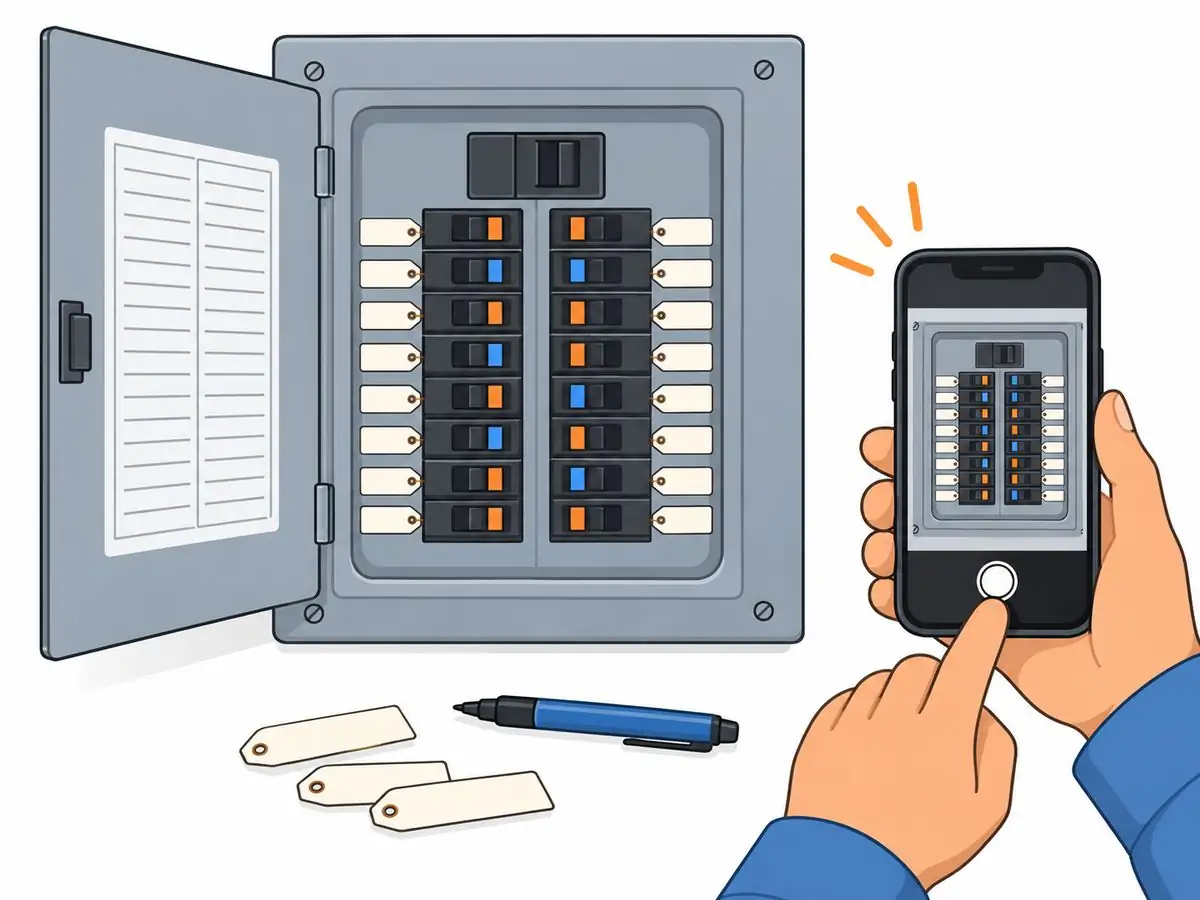
1. Open the panel door. Look for the main breaker. It is usually a large breaker at the top or a separate switch.
2. Look for an existing label. Many panels have a directory on the door. Treat it as a starting guess. Old labels are often wrong.
3. Get a helper. One person watches the panel and one goes through the house.
4. Set up a signal. Plug a radio or lamp into the first outlet to test. A plug-in outlet tester with a light also works.
5. Switch one breaker off. Flip one breaker to off. The helper checks the outlet and the lights in the room. Say aloud what went off.
6. Write it down. Put a number on a sheet next to the breaker, with what it controls. List every outlet, light and appliance that went dead.
7. Switch the breaker back on. Flip it fully off, then fully on. Stay clear of the panel while you do.
8. Repeat for each breaker. Move through the panel from top to bottom.
9. Check big loads. Water heater, range, dryer, AC and furnace usually have large two-pole breakers.
10. Make a clear label. Use a printed or neatly written label for each breaker: "Kitchen outlets left of sink," not "Kitchen."
11. Take a photo. Keep a picture of the finished directory on your phone.
Tips for a better label
- Use room names and wall sides, and note any shared circuits.
- Mark the main breaker and any breaker you want to find fast, such as the one for the furnace.
- Use pencil on a tape strip so you can change it later.
- If some circuits control a few rooms, note them all.
Take a photo and keep a copy
Once you have labeled the panel, store a photo of it on your phone and print a copy to keep in a drawer near the panel. If you move or sell the house, the next owner will thank you. Update the labels when you add circuits or change the use of a room.
Know your main breaker and your subpanels
Find the main breaker and learn how to turn it off. Find any subpanels, such as in a garage or an addition. Label each one with where it feeds and which breaker in the main panel feeds it. In an emergency, you may need to cut power quickly to the whole house or to one area.
Related guides
- How to Babyproof Electrical Outlets and Cords
- Three-Way Switch Not Working: How to Find the Problem
- Lights Dim When Appliance Starts: What It Means
FAQ
Can I turn off several breakers at once?
It is better to test one at a time. Turning off the main breaker kills power to the whole house.
What if I cannot find the breaker for an outlet?
It may be on a subpanel or on a circuit that serves several rooms. Test it with a tester or ask an electrician.
Is it normal for a panel to feel warm?
A slight warmth is usual. Hot or buzzing is not.
Should I label with a marker on the panel face?
Use the directory card or a paper label so the markings can be updated.
When to call an electrician
Call a licensed electrician if the panel is old, shows burn marks, uses fuses and you want a modern panel, or if you plan to add circuits. See How to reset a tripped breaker for the basic reset steps.
More from this topic
- How to Map Your Breaker Panel in One Afternoon: Learn how to map your breaker panel: label every breaker to its rooms and outlets with a lamp, a helper and a...
- How to Test a Circuit Breaker With a Multimeter: Learn how to test a circuit breaker: check for tripped positions, test voltage with a multimeter, and know...
- Breaker Will Not Reset: What to Do: Breaker will not reset? Unplug devices, flip it fully off then on and learn what a repeat trip means. Safe...
- How to Prevent Overloading a Circuit: Learn how to prevent overloading a circuit by adding up the load, spreading appliances across circuits, and...
- Circuit Breaker Keeps Tripping When Microwave Runs: Circuit breaker keeps tripping when microwave runs? Learn the usual causes, a safe way to test them and when...
 Electrical BasicsHow to Test a Circuit Breaker With a MultimeterLearn how to test a circuit breaker: check for tripped positions, test voltage with a multimeter, and know when the breaker itself is bad.
 Electrical BasicsBreaker Will Not Reset: What to DoBreaker will not reset? Unplug devices, flip it fully off then on and learn what a repeat trip means. Safe steps and when to call an electrician.Electrical BasicsHow to Prevent Overloading a CircuitLearn how to prevent overloading a circuit by adding up the load, spreading appliances across circuits, and reading the warning signs early.
 Electrical BasicsCircuit Breaker Keeps Tripping When Microwave RunsCircuit breaker keeps tripping when microwave runs? Learn the usual causes, a safe way to test them and when to stop and call a licensed electrician.