
How to Map Your Breaker Panel in One Afternoon
Part of: Electrical safety
- Difficulty
- Easy
- Time
- 1 to 2 hours with a helper
- Tools
- A lamp or outlet tester, your phone or a notepad, a helper, a circuit directory sheet or masking tape
- Call a pro if
- The panel is warm, buzzing, rusted or smells of burning, breakers will not stay on, or you find doubled-up wires on breakers you did not expect, since those deserve an electrician's look.
In this guide
- Power off first
Every panel has a few scrawled words like "kitchen" that turn out to mean "half the kitchen plus the garage." Learning how to map your breaker panel properly takes one afternoon with a helper, and it pays off every time a breaker trips, an outlet dies or you start a project. It is also the difference between guessing and knowing in an emergency.
1. Gather the simple kit
You need almost nothing.
1. A plug-in lamp or an outlet tester that lights up.
2. A helper with a phone, or a loud voice between floors.
3. The circuit directory card on the panel door, or a printed sheet.
4. Masking tape and a marker for temporary labels while you verify.
2. Record what is already labeled
Start from whatever truth exists.
1. Copy the existing directory into your notes exactly as written.
2. Note the main disconnect and any large double breakers: range, dryer, air conditioner, water heater.
3. Treat every existing label as a rumor until you verify it.
4. Photograph the panel before you touch anything, so you can restore positions if needed.
3. Work one breaker at a time
The method is simple and slow on purpose.
1. Turn all sensitive electronics off first: computers and TVs dislike surprise outages.
2. Switch one breaker off. Your helper then carries the lamp through the house and plugs it into each outlet and tries each light.
3. Shout or text the results; every dead outlet and light belongs to that breaker.
4. Flip it back on and confirm power returns before moving to the next.
4. Test outlets, lights and fixed appliances
Circuits hide in more places than outlets.
1. Check ceiling lights, fans and switched outlets in each room.
2. Note which fixed appliances are on which breaker: furnace, dishwasher, disposal, garage door opener.
3. Test exterior outlets and the garage; they are often paired with odd rooms.
4. An outlet tester with lights speeds this up and shows wiring faults as a bonus.
5. Handle the surprises calmly
Every panel has a few.
1. One breaker feeding two rooms on different floors is common, not a fault.
2. A breaker that seems to do nothing may feed an attic fan, a doorbell transformer or a disconnected circuit; label it "unknown, feeds nothing found."
3. Outlets that stay live with every breaker off are on a circuit you missed; start again with the big double breakers.
4. Never solve a mystery by opening the panel cover; that is where DIY ends, as diy electrical work explains.
6. Write the directory like a future stranger will read it
The label is the deliverable.
1. Write specific labels: "kitchen counter outlets east" beats "kitchen."
2. Number the breakers by position if the panel lacks numbers, top to bottom, left then right.
3. Note the amperage of each breaker next to its label.
4. Date the directory; panels change as electricians add circuits.
7. Make it durable and shared
A map nobody can find helps nobody.
1. Fill in the directory card neatly, or tape a printed sheet inside the panel door.
2. Save a photo of the finished directory to your phone and share it with the household.
3. Update it the day any circuit changes, not someday.
4. Fold the map into your first week in a new home routine if you just moved.
Common mistakes
- Trusting old labels without verifying them.
- Flipping multiple breakers at once and losing track of what feeds what.
- Forgetting to test lights, fans and exterior outlets.
- Leaving "unknown" breakers unlabeled instead of marking them as unverified.
- Mapping alone with a lamp and a staircase instead of with a helper and a phone.
Related guides
FAQ
How do I find which breaker controls an outlet?
Plug a lamp or outlet tester into the outlet, then flip breakers off one at a time until the lamp goes out. A helper at the panel with you at the outlet, connected by phone, makes it fast.
Why does one breaker control two rooms?
Circuits were laid out by wire path, not by room logic. Bedrooms sharing a circuit is common and harmless as long as the combined load stays reasonable.
What if a breaker is unlabeled and controls nothing I can find?
It may feed a disconnected circuit, an outdoor fixture or something hidden like an attic fan. Label it as unverified with the date, and ask an electrician to trace it next time one visits.
How often should I re-map my panel?
Re-map after any electrical work, after a renovation, or when you notice a label that no longer matches reality. Otherwise, a verified map lasts for years.
More from this topic
- How to Find Your Electrical Panel and Label Breakers: How to find your electrical panel and label breakers in a new home. Safe steps with a helper, a radio or...
- How to Test a Circuit Breaker With a Multimeter: Learn how to test a circuit breaker: check for tripped positions, test voltage with a multimeter, and know...
- How to Prevent Overloading a Circuit: Learn how to prevent overloading a circuit by adding up the load, spreading appliances across circuits, and...
- Breaker Will Not Reset: What to Do: Breaker will not reset? Unplug devices, flip it fully off then on and learn what a repeat trip means. Safe...
- Outlet Not Working in One Room: How to Fix It: Outlet not working in one room? Check the GFCI, the breaker and the plug first. Safe steps, tools and when to...
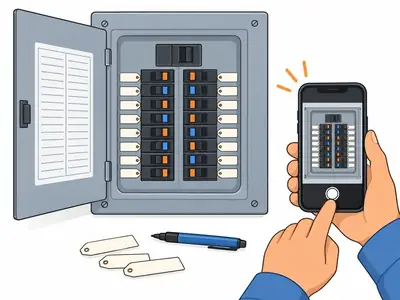 Electrical BasicsHow to Find Your Electrical Panel and Label BreakersHow to find your electrical panel and label breakers in a new home. Safe steps with a helper, a radio or tester, and a clear panel map. Know when to call a pro.
 Electrical BasicsHow to Test a Circuit Breaker With a MultimeterLearn how to test a circuit breaker: check for tripped positions, test voltage with a multimeter, and know when the breaker itself is bad.Electrical BasicsHow to Prevent Overloading a CircuitLearn how to prevent overloading a circuit by adding up the load, spreading appliances across circuits, and reading the warning signs early.
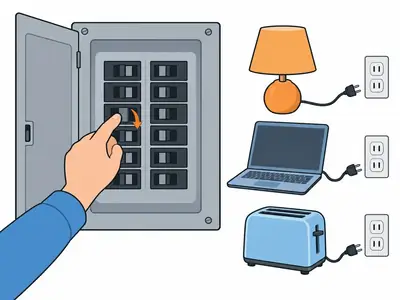 Electrical BasicsBreaker Will Not Reset: What to DoBreaker will not reset? Unplug devices, flip it fully off then on and learn what a repeat trip means. Safe steps and when to call an electrician.
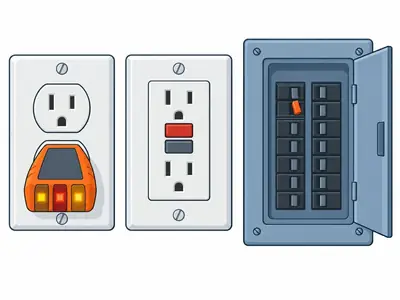 Electrical BasicsOutlet Not Working in One Room: How to Fix ItOutlet not working in one room? Check the GFCI, the breaker and the plug first. Safe steps, tools and when to call an electrician.