
Breaker Will Not Reset: What to Do
Part of: Electrical safety
- Difficulty
- Easy to medium
- Time
- 15 to 40 minutes
- Tools
- Flashlight, plug-in outlet tester (optional), a helper
- Call a pro if
- the breaker trips again right away, it feels hot, you smell burning or see scorch marks, the breaker will not stay on at all, or the panel is wet or rusty
In this guide
- Power off first
When a breaker will not reset, the cause is an overload, a short or a worn breaker. A breaker that will not reset is telling you something. It may be a simple overload, or it may be a short circuit or a failing breaker. Work through the safe checks below, and stop and call an electrician when the signs point to a fault.
This guide is part of our wider guide to electrical problems and safety.
What a trip means
A breaker trips for one of three reasons. It can be an overload, meaning too many devices on one circuit. It can be a short circuit, where hot and neutral wires touch. Or it can be a ground fault, where current leaks to ground. A breaker that will not reset at all, even with everything unplugged, usually points to a short in the wiring or a bad breaker.
Step by step
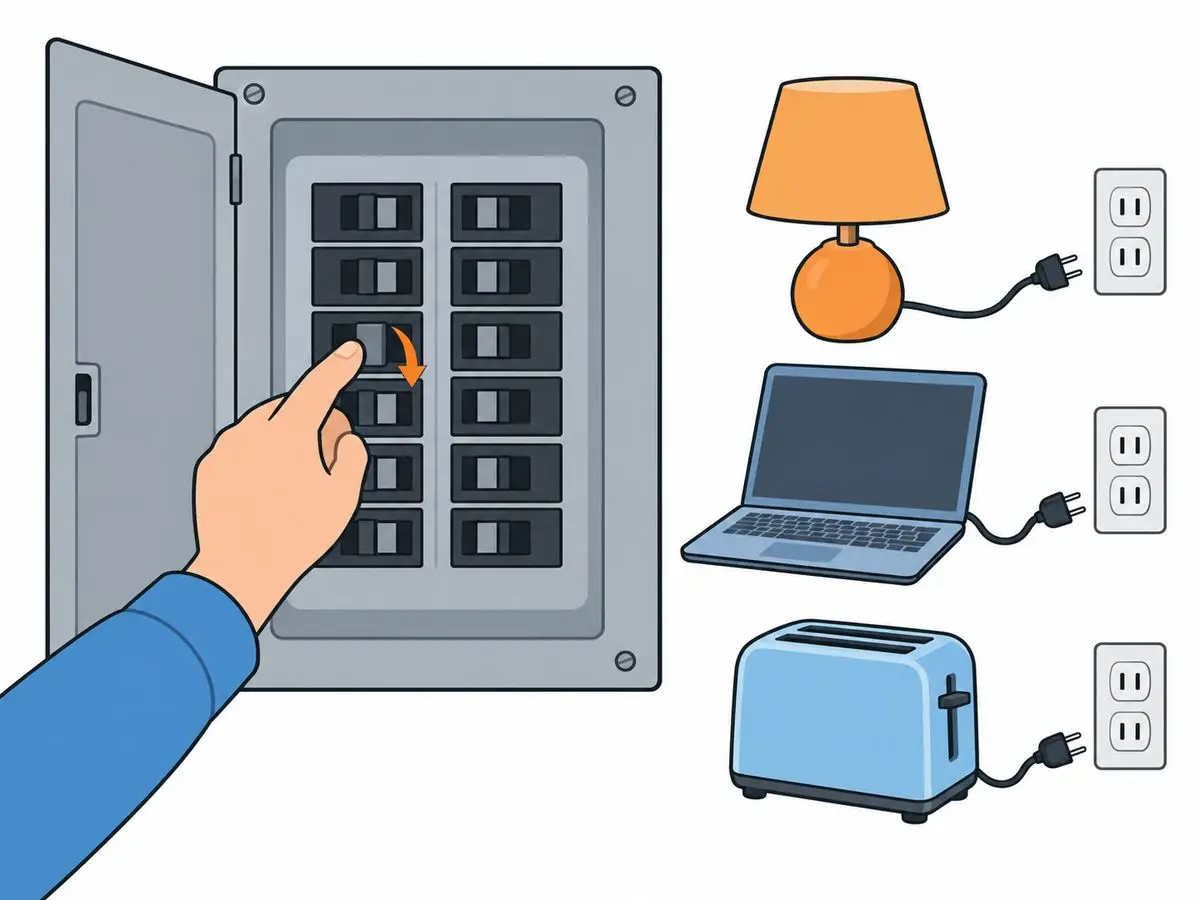
1. Unplug everything on the affected circuit and turn off the lights. Include power strips and chargers.
2. Open the panel door only. Do not remove the inner cover.
3. Find the tripped breaker. It will sit in the middle position or look different from the others.
4. Push it fully to off. You must push past the middle to the off position first. Then flip it to on. Many people flip it only to on and wonder why it does not hold.
5. Stand to one side of the panel when you do this. Do not stand in front of it.
6. If it stays on, plug devices back one at a time. The device that trips it again is the problem. See How to reset a tripped breaker.
7. If it trips immediately with everything unplugged, leave it off. There may be a short in the wiring or an outlet. Do not keep resetting it.
8. If it will not move to the on position, the breaker may be bad, or the circuit has a fault. Leave it off.
9. Check GFCI outlets on the circuit and reset them. See GFCI outlet will not reset.
Possible causes
- A device with a damaged cord or a failing motor.
- Water in an outdoor or bathroom outlet.
- A loose or burned wire in a box.
- A worn breaker that no longer holds.
- Too many devices on one circuit.
What not to do
- Do not tape or hold a breaker on.
- Do not replace a breaker with a larger one. The wire may not handle it.
- Do not remove the panel cover.
- Do not keep resetting a breaker that trips right away.
What to tell an electrician
Say which breaker it is, what was plugged in, what was running when it tripped, and whether it trips at once or after a while. Note any smell, heat, noise or recent water. If you have a label on the panel for that breaker, give the room names. These details help the electrician find the fault faster.
Why a breaker gets weaker over time
Breakers contain a small mechanism that can wear out after many trips, or after an overload that heated it. An aging breaker can trip under a lighter load than it should, or sit loosely in its slot. Heat marks on the breaker or a buzzing sound from the panel are warnings. Do not try to swap a breaker yourself, since the bus bars inside the panel stay live. A licensed electrician can test the breaker and replace it with the exact type your panel needs.
Separate overload from fault
A good test for overload is to unplug everything and reset. If it holds, plug devices in one at a time and note which one trips it. If one device trips it alone, that device is faulty. If it only trips when several things run together, you have too many loads on that circuit. If it trips with nothing plugged in, suspect the wiring. This simple split saves time and tells the electrician where to look.
Related guides
- Lights Dim When Appliance Starts: What It Means
- Hose Bib Vacuum Breaker Leaks: How to Stop Water Spraying From the Spigot
- How to Fix a Deadbolt That Will Not Throw All the Way
When to call a pro
If a breaker trips again right after a proper reset with loads unplugged, stop resetting it. A breaker that will not hold is reporting a short or a ground fault, and forcing it risks a fire inside the walls. Call a licensed electrician, and treat it as urgent if the panel feels hot, smells burnt, or shows rust or scorch marks. Sources: NFPA 70 (NEC), NFPA electrical fire safety guidance.
FAQ
Is it safe to reset a breaker several times?
Once is normal. Repeated trips mean a fault. Stop and call an electrician.
Why does the breaker feel warm?
Slight warmth under load is common. Hot is not. Turn off the circuit and call an electrician.
Can a breaker go bad?
Yes, with age or after many trips.
Do I need a permit to replace a breaker?
Rules vary. In most places an electrician should do it.
More from this topic
- How to Prevent Overloading a Circuit: Learn how to prevent overloading a circuit by adding up the load, spreading appliances across circuits, and...
- How to Reset a Tripped Breaker Safely: How to reset a tripped breaker safely, what usually causes it, and the warning signs that mean you should...
- Circuit Breaker Keeps Tripping When Microwave Runs: Circuit breaker keeps tripping when microwave runs? Learn the usual causes, a safe way to test them and when...
- How to Find Your Electrical Panel and Label Breakers: How to find your electrical panel and label breakers in a new home. Safe steps with a helper, a radio or...
- How to Map Your Breaker Panel in One Afternoon: Learn how to map your breaker panel: label every breaker to its rooms and outlets with a lamp, a helper and a...
 Electrical BasicsHow to Reset a Tripped Breaker SafelyHow to reset a tripped breaker safely, what usually causes it, and the warning signs that mean you should call an electrician. Steps and safety tips included.
 Electrical BasicsCircuit Breaker Keeps Tripping When Microwave RunsCircuit breaker keeps tripping when microwave runs? Learn the usual causes, a safe way to test them and when to stop and call a licensed electrician.
 Electrical BasicsHow to Find Your Electrical Panel and Label BreakersHow to find your electrical panel and label breakers in a new home. Safe steps with a helper, a radio or tester, and a clear panel map. Know when to call a pro.Electrical BasicsHow to Map Your Breaker Panel in One AfternoonLearn how to map your breaker panel: label every breaker to its rooms and outlets with a lamp, a helper and a circuit directory you will actually use.