
How to Install a Shower Seat That Is Safe to Sit On
Part of: Basic plumbing
- Difficulty
- Moderate
- Time
- 1 to 3 hours
- Tools
- Tape measure, pencil, level, stud finder, drill with tile bits, wall anchors rated for the load, silicone sealant, screwdriver, masking tape, a helper
- Call a pro if
- There is no framing where the seat must go, the wall is drywall only, or the user needs a seat with a specific weight rating and you cannot confirm the fixing can take it.
In this guide
A shower seat makes a shower safer for anyone who tires standing, recovers from surgery, has balance problems or is simply getting older. It is also one of the most useful small changes in a bathroom. The mistake people make is buying a seat and mounting it wherever it fits, rather than where there is something solid behind the wall. Here is how to install a shower seat that is genuinely safe.
This guide is part of our wider guide to bathroom fixtures, tile and grout.
1. Decide between types
Wall mounted folding seat: fixed to the shower wall, folds up when not in use. The most useful in a small shower, and the most dependent on good fixing.
Freestanding bench: stands on the shower floor on legs. No drilling, easy to move, good for a rental. It takes up floor space and can be unstable if the floor is not level.
Built-in seat: tiled into the shower during a remodel. The most solid and the most permanent.
Transfer bench: straddles the tub edge for someone who cannot step over. A different product, and often the right one for a bath.
2. Ask the user where it should go
A seat in the wrong place is worse than none. Ask the person who will use it to stand in the shower and show where they would sit, and check that the shower controls and the shower head are reachable from that position.
Height matters: a seat around 17 to 19 inches from the shower floor suits most adults. Adjust for the user's height and leg length.
3. Check what is behind the wall
- Use a stud finder, and confirm the framing with a small drill in a hidden spot.
- Tile over cement board with studs behind is the ideal situation.
- Drywall alone will not hold a seat under body weight, whatever the anchor says.
- If there is no framing, add blocking: open the wall, fix a wood plate between the studs, then patch and retile.
This is the step to get right. A seat that pulls out of the wall mid-shower is a serious injury.
4. Choose a seat rated for the load
Look for a seat rated to at least 250 pounds, with a proper mounting plate and stainless hardware. Cheap seats with small flanges and short screws are the ones that fail.
Stainless steel, or a good quality plastic that will not rust, is the right choice in a wet area.
5. Mark and drill
1. Hold the seat or its mounting plate in position and level it.
2. Mark the fixing holes through the plate.
3. Tape over the marks so the drill bit does not skate on the tile.
4. Drill with a tile bit at low speed, no hammer action.
5. Switch to the right bit for the material behind.
6. Fix and seal
1. Put silicone into each hole before the screw.
2. Drive the screws into the framing or the rated anchors and tighten evenly.
3. Run a bead of silicone around the mounting plate where it meets the tile, leaving the bottom edge open so water can drain.
4. Wipe the excess and let it cure.
7. Test it properly
Sit on the seat and shift your weight. Then have a heavier adult do the same. Push down and sideways, the way someone would when standing up. If there is any movement, any creak or any give, stop and redo the fixing.
Do not accept "it feels solid enough". A wet person standing up puts a lot of load on one side of a seat.
8. Add the supporting changes
A seat works best with the other basics:
- A grab bar nearby, so the user can pull up and steady themselves. Our guide on installing a grab bar in the bathroom covers the fixing.
- A hand-held shower head, which makes washing while seated much easier.
- A non-slip floor or mat.
- Good lighting, and a place to put soap and shampoo within reach.
9. Look after it
- Wipe the seat after use and leave it folded up to dry.
- Check the hardware every few months for movement or rust.
- Reapply silicone if it peels or turns black.
Common mistakes
- Fixing a seat to drywall with ordinary anchors.
- Choosing a seat with a low weight rating.
- Sealing all the way around the plate, which traps water.
- Putting the seat where the shower controls cannot be reached.
- Testing with a light push instead of real body weight.
Related guides
- How to Install a Shower Curtain Rod That Stays Up
- How to Install a Shower Niche in a Tiled Wall
- How to Install a Shower Valve Trim and Handle
- How to Install a Shower Shelf Without Damaging Tile or Waterproofing
- How to Fix a Loose Shower Head Arm That Drips or Wobbles
- How to Replace a Toilet Seat: A Simple Step by Step Guide
FAQ
How much weight should a shower seat hold?
Look for a seat rated to at least 250 pounds, fixed into framing or rated anchors, and test it yourself before use.
Can I install a shower seat without drilling?
A freestanding bench needs no mounting and suits a rental. A wall mounted seat must be screwed into something solid.
Where should a shower seat be positioned?
Where the user naturally sits, about 17 to 19 inches from the shower floor, with the controls and shower head within reach.
Do I need to seal the screw holes?
Yes. Every hole in a shower wall needs silicone, or water gets behind the tile.
More from this topic
- How to Install a Grab Bar in the Bathroom: How to install a grab bar in the bathroom: pick height and position, find studs or add blocking, use tile...
- How to Install a Shower Curtain Rod That Stays Up: Learn how to install a shower curtain rod: measure the opening, choose tension or fixed, set the height, fix...
- How to Install a Shower Niche in a Tiled Wall: Learn how to install a shower niche: plan the position and size, cut the opening, fit a waterproof niche box,...
- How to Install a Bidet Seat on Your Toilet Step by Step: Learn how to install a bidet seat on a standard toilet. Check the fit, shut off the water, add a T-adapter...
- How to Install a Bathroom Vanity Top and Sink: Install a bathroom vanity top: measure the cabinet, pick the sink type, cut the opening, bed and seal the...
 BathroomHow to Install a Grab Bar in the BathroomHow to install a grab bar in the bathroom: pick height and position, find studs or add blocking, use tile anchors, seal holes and test it.
 BathroomHow to Install a Shower Curtain Rod That Stays UpLearn how to install a shower curtain rod: measure the opening, choose tension or fixed, set the height, fix into solid surfaces and stop it slipping.
 BathroomHow to Install a Shower Niche in a Tiled WallLearn how to install a shower niche: plan the position and size, cut the opening, fit a waterproof niche box, waterproof every joint, then tile and seal it.
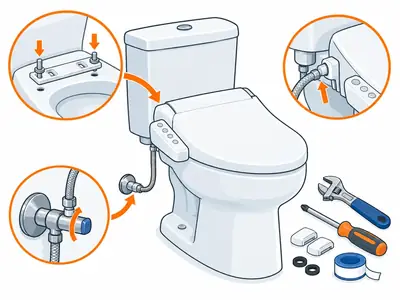 BathroomHow to Install a Bidet Seat on Your Toilet Step by StepLearn how to install a bidet seat on a standard toilet. Check the fit, shut off the water, add a T-adapter and mount the seat with simple steps and no tools.
 BathroomHow to Install a Bathroom Vanity Top and SinkInstall a bathroom vanity top: measure the cabinet, pick the sink type, cut the opening, bed and seal the top, fit splashes, keep plumbing reachable.