
How to Use a Non-Contact Voltage Tester Safely
Part of: Electrical safety
- Difficulty
- Easy
- Time
- Five minutes per test
- Tools
- Non-contact voltage tester, a known live outlet, work gloves
- Call a pro if
- The tester reads live after you switched the breaker off, you find aluminum wiring or damaged cables, or you are ever unsure what the reading means, since guessing with electricity is dangerous.
In this guide
- Power off first
Before you change an outlet, a switch or a light fixture, you need to know the power is really off. A non-contact voltage tester tells you without touching a single conductor. Here is how to use a non-contact voltage tester the right way.
1. Know what the tool does
- A non-contact tester senses the electric field around a live wire through the insulation.
- It beeps, flashes or both when it detects voltage.
- It cannot tell you how much voltage, only that voltage is present.
- It can miss shielded or deeply buried wires, so it is one check, not the only check.
2. Test the tester first
1. Turn the tester on and check the battery indicator if it has one.
2. Hold the tip near a cord you know is live, like a lamp that is switched on.
3. Confirm it beeps or flashes.
4. If it does not respond on a known live source, replace the batteries or the tester before you trust it.
3. Switch the power off
1. Identify the breaker for the circuit at the panel.
2. Switch it off and note it clearly.
3. If the panel labels are unclear, our guide on finding your electrical panel and labeling breakers walks through it.
4. Tape a note on the panel so nobody restores power while you work.
4. Test before you touch
1. Hold the tester tip at the outlet slots or near each wire in the box.
2. Test every wire, not just the black one. A box can hold more than one circuit.
3. Move slowly along the wire; a quick pass can miss a reading.
4. Only touch the wires when every conductor reads dead.
5. Test at fixtures and switches
1. At a light fixture, test the wires at the ceiling box with the wall switch on and off.
2. At a switch, test both terminals. A switch loop can surprise you with a live wire where you do not expect it.
3. Watch for shared neutrals in older homes, where another circuit stays live.
4. Retest after any change before you close things up.
6. Retest the tester
1. Go back to the known live source.
2. Confirm the tester still beeps or flashes.
3. This proves the dead reading was real and not a dead battery.
4. Make it a habit every single time.
7. Know the limits
- Testers can give false live readings from static or nearby circuits, called phantom voltage.
- They can also miss voltage inside metal sheathed cable or junction boxes with metal covers.
- When a reading does not make sense, verify with a multimeter. Our guide on testing an outlet with a multimeter covers that tool.
- If anything about the wiring looks wrong, stop and call an electrician.
8. Build safe habits
- Test every time, even if you just switched the breaker off yourself.
- Replace batteries at the first weak reading.
- Keep the tester clean and dry, and store it in your tool bag, not loose in a drawer.
- Never use a tester with a cracked case or a frayed tip.
Common mistakes
- Trusting the tester without proving it on a live source first.
- Testing only the black wire and missing a second live circuit in the box.
- Assuming a dead wall switch means dead wires at the fixture.
- Holding the tester too far from the wire and reading a false all clear.
- Skipping the retest after the battery has been knocked around in a tool bag.
Related guides
FAQ
Are non-contact voltage testers accurate?
They reliably show whether voltage is present near the tip, but they can give false live readings and miss shielded wires. Confirm dead circuits with a second test when it matters.
Why does my tester beep near dead wires?
Phantom voltage from nearby live cables can trigger it. A multimeter gives a definite answer in those cases.
Can I use a voltage tester on any outlet?
Yes, on standard outlets, switches, cords and fixture wires. It is the right first tool before any electrical DIY.
What should I do if a wire still reads live with the breaker off?
Stop. You may have the wrong breaker, a shared neutral or a wiring fault. Verify the circuit or call an electrician.
More from this topic
- How to Test an Outlet With a Multimeter: Learn how to test an outlet with a multimeter, what readings to expect and which safer tools to use first....
- Voltage Tester vs Multimeter: Voltage tester vs multimeter: which one a homeowner needs. We compare the Klein NCVT-3P, Fluke 1AC II and...
- How to Hide Cords Safely: Learn how to hide cords safely with raceways, clips and covers, and which shortcuts behind walls and under...
- How to Set Up a Smart Plug Safely: Learn how to set up a smart plug: check the load, plug it in, connect it to WiFi in the app, name it and set...
- Outlet Feels Warm? What It Means and What to Do: If an outlet feels warm, it can mean overload, loose wiring or a failing device. Learn which warmth is...
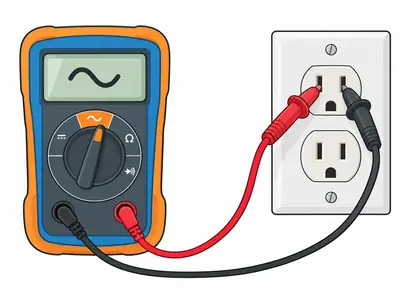 Electrical BasicsHow to Test an Outlet With a MultimeterLearn how to test an outlet with a multimeter, what readings to expect and which safer tools to use first. Safety rules and when to call an electrician.
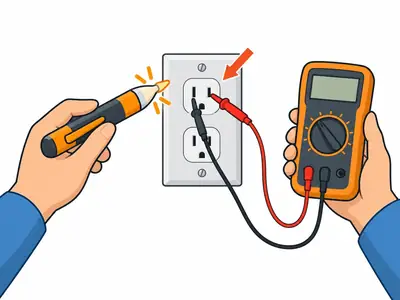 Tools and BasicsVoltage Tester vs MultimeterVoltage tester vs multimeter: which one a homeowner needs. We compare the Klein NCVT-3P, Fluke 1AC II and Klein MM400 by stated specs as of Nov 2026.
 Electrical BasicsHow to Hide Cords SafelyLearn how to hide cords safely with raceways, clips and covers, and which shortcuts behind walls and under rugs put your home at risk.
 Electrical BasicsHow to Set Up a Smart Plug SafelyLearn how to set up a smart plug: check the load, plug it in, connect it to WiFi in the app, name it and set schedules without overloading the outlet.Electrical BasicsOutlet Feels Warm? What It Means and What to DoIf an outlet feels warm, it can mean overload, loose wiring or a failing device. Learn which warmth is normal, which is dangerous and the safe checks.