
How to Test an Outlet With a Multimeter
Part of: Electrical safety
- Difficulty
- Medium
- Time
- 10 to 20 minutes
- Tools
- Digital multimeter with insulated probes, plug-in outlet tester, flashlight, safety glasses
- Call a pro if
- you see sparks, scorch marks, a burning smell, readings far from normal, or an outlet that feels hot
In this guide
- Power off first
A multimeter can tell you whether an outlet has power and whether the voltage is in a normal range. You can test an outlet with a multimeter in a couple of minutes, but this is one of the few jobs where you touch a live circuit. If you are not comfortable with that, use a simple plug-in outlet tester or call an electrician. Read the safety section before you begin.
This guide is part of our wider guide to electrical problems and safety.
Start with safer checks
Before a multimeter, plug in a lamp or a plug-in outlet tester. A tester with three lights shows whether the outlet has power, whether the wires are reversed and whether there is a ground. Use it first. A non-contact voltage tester held near the slots will also tell you if the outlet is live. These tools do not need you to touch a metal probe to a live contact.
Know your meter
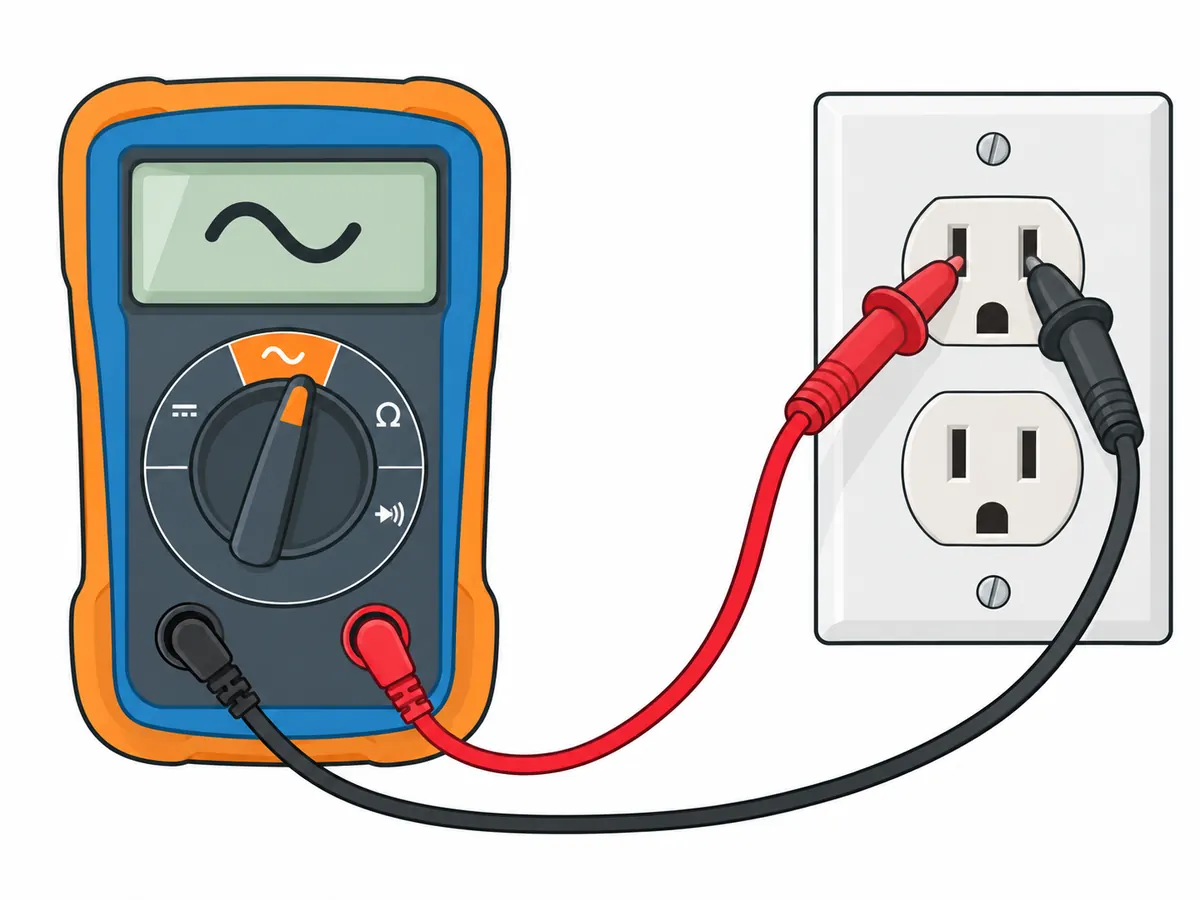
A multimeter has a dial, two probes and several ports. The black probe goes in the port marked COM. The red probe goes in the port marked for voltage, often marked with a V. Set the dial to AC voltage, shown as V with a wavy line. Choose a range that is above the expected voltage. Standard household outlets in many countries give about 120 volts, and in others about 230 volts. Check what is normal where you live.
Make sure the meter and the probes are in good shape. The probe insulation should have no cracks, and the tips should be clean. Use a meter rated for household voltage, with a CAT II or CAT III safety rating printed on it. Stand on a dry floor and keep your other hand away from metal and the wall. A first-time user should stop here and use a plug-in outlet tester or an electrician instead.
Step by step
1. Put on safety glasses. Stand on a dry floor. Do not touch plumbing or metal while you test.
2. Check the meter. Set it to AC voltage. Test it on an outlet you know works, or use the meter's own self test if it has one.
3. Insert the probes. Hold each probe by the insulated handle, behind the finger guard. Keep your other hand away from metal and from the wall.
4. Test hot to neutral. Put one probe in the shorter slot, the hot side, and the other in the longer slot, the neutral side. A normal reading in many homes is about 110 to 125 volts.
5. Test hot to ground. Keep one probe in the hot slot and put the other in the round ground hole. The reading should be close to the hot to neutral reading. If there is no reading, the ground may be missing.
6. Test neutral to ground. The reading should be very close to zero, usually under a volt or two. A higher reading can mean a wiring problem.
7. Remove the probes one at a time, and turn the meter off.
8. Note your readings. Write them down if you plan to call an electrician.
What the readings mean
- No voltage hot to neutral: the outlet has no power. Check the breaker and any GFCI. See GFCI outlet will not reset and Outlet not working in one room.
- Low voltage: loose connections, a heavy load on the circuit or a utility problem.
- High voltage: a utility or wiring issue. Call an electrician.
- Hot to ground but not hot to neutral: an open neutral. Call an electrician right away.
- Neutral to ground has voltage: a wiring fault. Stop using the outlet.
Testing a removed outlet or a dead outlet
You can also test a switched off outlet for continuity, but only with the power off and the outlet out of the circuit. Turn off the breaker, test with a non-contact tester, and then use the meter's continuity setting. This tests the outlet, not the house wiring. If you replace the outlet, see How to replace an outlet.
Keep a record
Write down the date, the outlet location and your readings. If a problem comes back, you can show an electrician what you saw. A small notebook near the panel is a good place. It also helps to label which breaker feeds which outlets. See How to find your electrical panel and label breakers.
Related guides
- Replace Outlet Cover Plate (and Switch Plates)
- How to Replace a Two-Prong Outlet Safely
- How to Replace a GFCI Outlet Safely: Line and Load Wiring Explained
- How to Install a USB Outlet to Replace a Standard Outlet
FAQ
What should an outlet read on a multimeter?
In many homes, about 110 to 125 volts between hot and neutral. Check what is normal in your area.
Is it safe to test an outlet with a multimeter?
It can be, with insulated probes and careful habits. A plug-in tester is safer for beginners.
Why do I get a reading on a dead outlet?
A phantom voltage can show up on an unconnected wire. Use a good meter and check connections.
Do I need an expensive meter?
No. Choose one rated for household voltage with good probes.
More from this topic
- How to Use a Non-Contact Voltage Tester Safely: Learn how to use a non-contact voltage tester: check it on a live source first, test wires and outlets the...
- Voltage Tester vs Multimeter: Voltage tester vs multimeter: which one a homeowner needs. We compare the Klein NCVT-3P, Fluke 1AC II and...
- How to Strip Electrical Wire Without Nicking the Copper: Learn how to strip electrical wire: choose the right gauge slot, score the insulation cleanly, and avoid the...
- How to Test a Circuit Breaker With a Multimeter: Learn how to test a circuit breaker: check for tripped positions, test voltage with a multimeter, and know...
- Lights Dim When Appliance Starts: What It Means: Lights dim when appliance starts? Learn what is normal, what points to an overloaded circuit or loose...
 Tools and BasicsVoltage Tester vs MultimeterVoltage tester vs multimeter: which one a homeowner needs. We compare the Klein NCVT-3P, Fluke 1AC II and Klein MM400 by stated specs as of Nov 2026.Electrical BasicsHow to Strip Electrical Wire Without Nicking the CopperLearn how to strip electrical wire: choose the right gauge slot, score the insulation cleanly, and avoid the nicks that cause failures.
 Electrical BasicsHow to Test a Circuit Breaker With a MultimeterLearn how to test a circuit breaker: check for tripped positions, test voltage with a multimeter, and know when the breaker itself is bad.
 Electrical BasicsLights Dim When Appliance Starts: What It MeansLights dim when appliance starts? Learn what is normal, what points to an overloaded circuit or loose connection and when to call an electrician.