
Washing Machine Not Filling with Water: What to Check
Part of: Appliances
- Difficulty
- Easy to moderate
- Time
- 15 to 45 minutes
- Tools
- Pliers, bucket, towels, flashlight, old toothbrush
- Call a pro if
- the inlet valve or the control board seems to be at fault
In this guide
- Power off first
- Water off first
When a washing machine not filling with water is the problem, the inlet valves and hoses are the first places to look. A washer that does not fill, or fills very slowly, stops the whole laundry day. The cause is often outside the machine, such as a closed valve or a kinked hose. Other times it is a clogged screen, a lid switch or a bad inlet valve. This guide goes through the checks in order, from the easy to the harder.
This guide is part of our wider guide to appliance problems.
Check the basics
1. Look at the cycle. Some washers wait before they fill, or use a sensing phase first.
2. Check that the door or lid is closed. A washer will not fill with the door open.
3. Check for a control lock or a delay start.
4. Try another cycle to see if the problem repeats.
Check the water supply
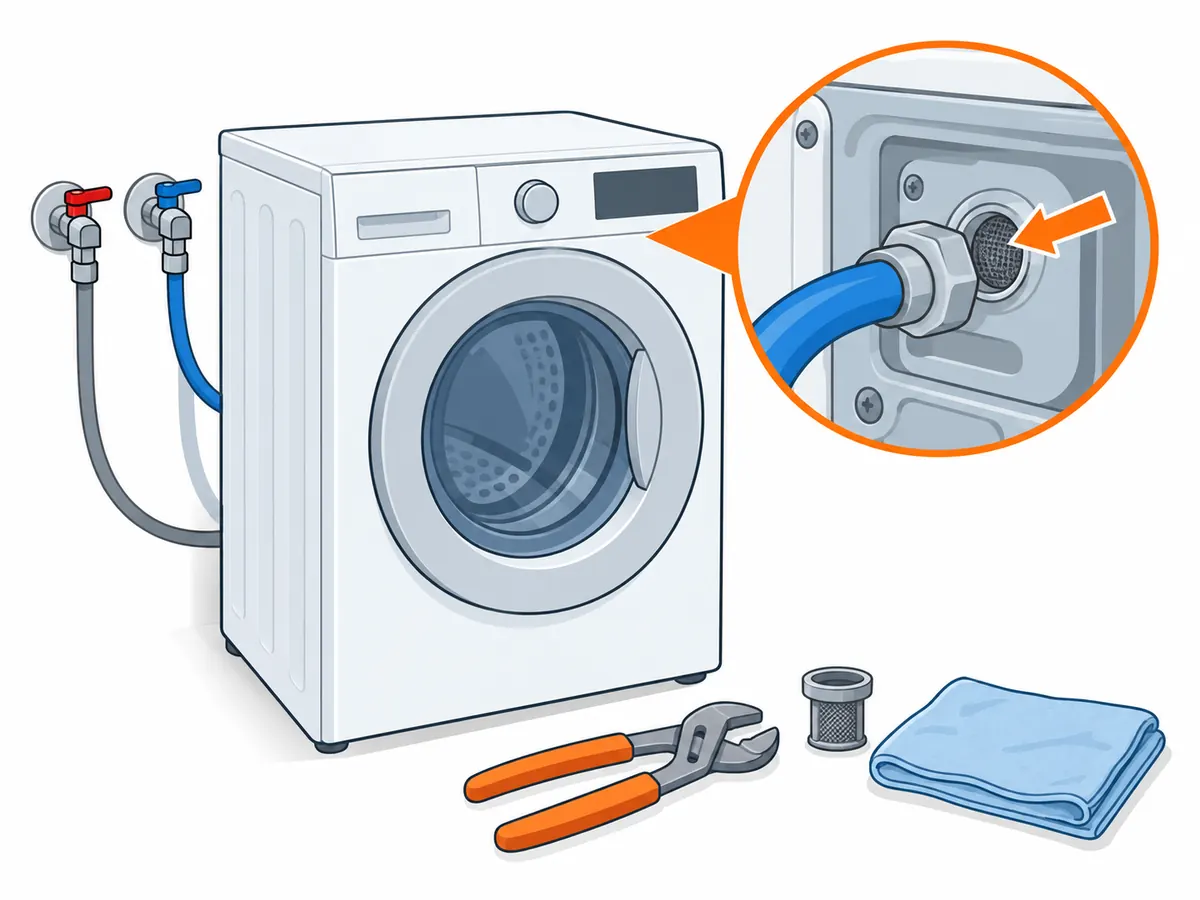
Look behind the washer. Both water valves should be fully open. The handles should line up with the pipe or be turned as far as they go. Check the hoses for kinks. Run water at a nearby faucet to see whether the house has water. If the valves are old and stuck, do not force them. See How to shut off the water main.
Step by step: clean the inlet screens
1. Turn off both water valves.
2. Unplug the washer.
3. Place a bucket and towels under the hoses.
4. Unscrew each hose from the back of the washer.
5. Look into the inlet ports. Each has a small screen.
6. Pull out the screen with pliers. Clean it with a toothbrush and rinse it.
7. Check the hose washers. Replace any that are cracked.
8. Reattach the hoses by hand, then add a small turn with pliers.
9. Open the valves and check for leaks.
10. Plug in the washer and run a cycle.
See Washing machine inlet screens: how to clean.
Hot and cold mix
If the washer fills slowly with hot or cold only, one supply may be blocked. Test each one: run a cycle set to hot, then another set to cold. If only one fails, the matching valve, hose or screen is blocked. Check the water heater too, since a cold supply may be due to a heater problem.
Signs that point to each cause
A washer that does not fill at all and hums may have a bad inlet valve. A washer that fills slowly has a clogged screen or low pressure. A washer that fills with only hot or only cold has one blocked line. A washer that does not start and shows a door code has a latch problem. A washer that fills, then drains at once may have a drain problem. See Washing machine not draining: what to check and How to fix low water pressure in one faucet.
Lid switch and water level
Top load washers have a lid switch. If the switch fails, the washer may not run. Press the lid down and listen for a click. Some washers also have a water level sensor, with a small tube that can clog. If the washer fills too little, or overfills, the sensor or the tube may be the cause. These parts need care, so see the manual or call a pro.
Prevention
Replace old hoses every few years. Clean the inlet screens twice a year. Keep the valves moving by opening and closing them now and then. Leave a few inches between the washer and the wall so the hoses do not kink.
When to call for service
If the valves are open, the screens are clean, the hoses are clear and the water pressure is good, but the washer still does not fill, the inlet valve or the control board is likely at fault. These need testing with a meter. If the machine is old, compare the repair estimate with the cost of a new washer.
Test the fill by hand
Run a short cycle and watch the hoses. If a hose shakes or hums when the cycle starts, water is reaching it. Feel the hose to check that it is firm with pressure, and then feel the other end. If the hose is hard and the washer is silent, the inlet valve is likely at fault. If the hose is soft and the water pressure at a nearby faucet is weak, the problem is the supply.
Front load and top load differences
Front loaders fill a small amount before the wash and may seem to fill slowly. They also lock the door and wait. Top loaders fill to a set level, and the lid switch matters. Check the manual to see what the normal fill looks like, and how long it takes. A normal fill can take several minutes in an efficient machine.
Related guides
- Water Softener Not Working: What to Check Before You Call
- Washing Machine Door Will Not Open: Why It Locks and How to Release It
- Washing Machine Shakes or Walks Across the Floor: How to Fix It
- How to Replace a Washing Machine Lid Switch
- How to Replace Washing Machine Hoses to Prevent Leaks
FAQ
Why is my washer slow to fill? A clogged inlet screen or low pressure is common.
Can a lid switch stop a fill? Yes. The washer will not start without a closed lid.
How often should I clean the screens? Twice a year.
Does a washer fill with hot and cold both? It depends on the cycle setting.
More from this topic
- Washing Machine Loud Noise: What to Check: Washer banging, grinding or squealing? Learn what each washing machine loud noise means, from unbalanced...
- Dishwasher Not Filling With Water: What to Check: A dishwasher not filling with water is usually a closed valve, a kinked line, a stuck float or a failed inlet...
- How to Drain a Washing Machine Full of Water: How to drain a washing machine that won't empty: bail, drain hose or pump filter methods that get the water...
- Washing Machine Inlet Screens: Washer filling slowly? Learn how to clean the washing machine inlet screens at the water hoses. Turn off the...
- Water Softener Not Working: What to Check Before You Call: Water softener not working? Check the salt level, salt bridge, bypass valve, power and settings. Simple steps...
 PlumbingWashing Machine Loud Noise: What to CheckWasher banging, grinding or squealing? Learn what each washing machine loud noise means, from unbalanced loads to worn bearings, and what to check.
 KitchenDishwasher Not Filling With Water: What to CheckA dishwasher not filling with water is usually a closed valve, a kinked line, a stuck float or a failed inlet valve. Check them in this order.
 PlumbingHow to Drain a Washing Machine Full of WaterHow to drain a washing machine that won't empty: bail, drain hose or pump filter methods that get the water out safely.
 KitchenWashing Machine Inlet ScreensWasher filling slowly? Learn how to clean the washing machine inlet screens at the water hoses. Turn off the water, remove the hoses and rinse the filters.
 PlumbingWater Softener Not Working: What to Check Before You CallWater softener not working? Check the salt level, salt bridge, bypass valve, power and settings. Simple steps to bring soft water back to your home.