
Caulk Gun Comparison: Red Devil and Newborn Models
Part of: Tools and everyday fixes
In this guide
- Chemical safety
A caulk gun looks like the simplest tool in the garage, but a poor one makes a messy bead, drips after you stop and tires your hand. The main spec to compare is thrust ratio, the multiplier between your hand force and the force on the plunger. Thick sealants like construction adhesive need a higher ratio. Thin caulk works with a lower one. Here are four hand guns from two makers.
This guide is part of our wider guide to bathroom fixtures, tile and grout.
How we compared these. We did not test these tools ourselves. This comparison is based on manufacturer specifications, retailer product pages and published reviews. We do not list prices because they change often and vary by store, kit and sale. Check the current price before you buy. We do not use affiliate links.
At a glance
| Red Devil 3985 | Newborn E-Z Thrust drip-free | Red Devil 3935 | Red Devil 3989 | |
|---|---|---|---|---|
| Frame | 9 in. half barrel | Steel half-barrel (cradle) | 9 in. composite | 9 in. extreme duty |
| Thrust ratio | 7:1 | 10:1 | 10:1 | 26:1 |
| Drip-free | Not stated | Yes, rod retracts after each pull | Yes | Not stated |
The models, one by one
Red Devil 3985
A 9 inch half barrel gun with a 7:1 thrust ratio. The low ratio suits thin sealants such as latex caulk. It is the simplest of the four.
Newborn E-Z Thrust drip-free
A steel half-barrel frame for 1/10 gallon cartridges, with a 10:1 ratio. The listing says the smooth pressure rod is quieter than a ratchet-style rod and retracts after each pull to help prevent dripping. It also has a built-in spout cutter and seal puncture tool.
Red Devil 3935
A composite 9 inch drip-free gun with a 10:1 ratio.
Red Devil 3989 extreme duty
A 26:1 thrust ratio, meant for thick materials.
How to choose
- Silicone and latex caulk for tubs and trim: a drip-free gun with 10:1 is a good fit.
- Thick adhesives: pick a high thrust ratio like the 26:1.
- How often you caulk: for a single bathroom, a basic gun is enough.
- Cut the nozzle at 45 degrees, and smaller than you think. You can always cut more.
- See our guides on caulking a bathtub and caulking a kitchen sink.
Getting a clean bead
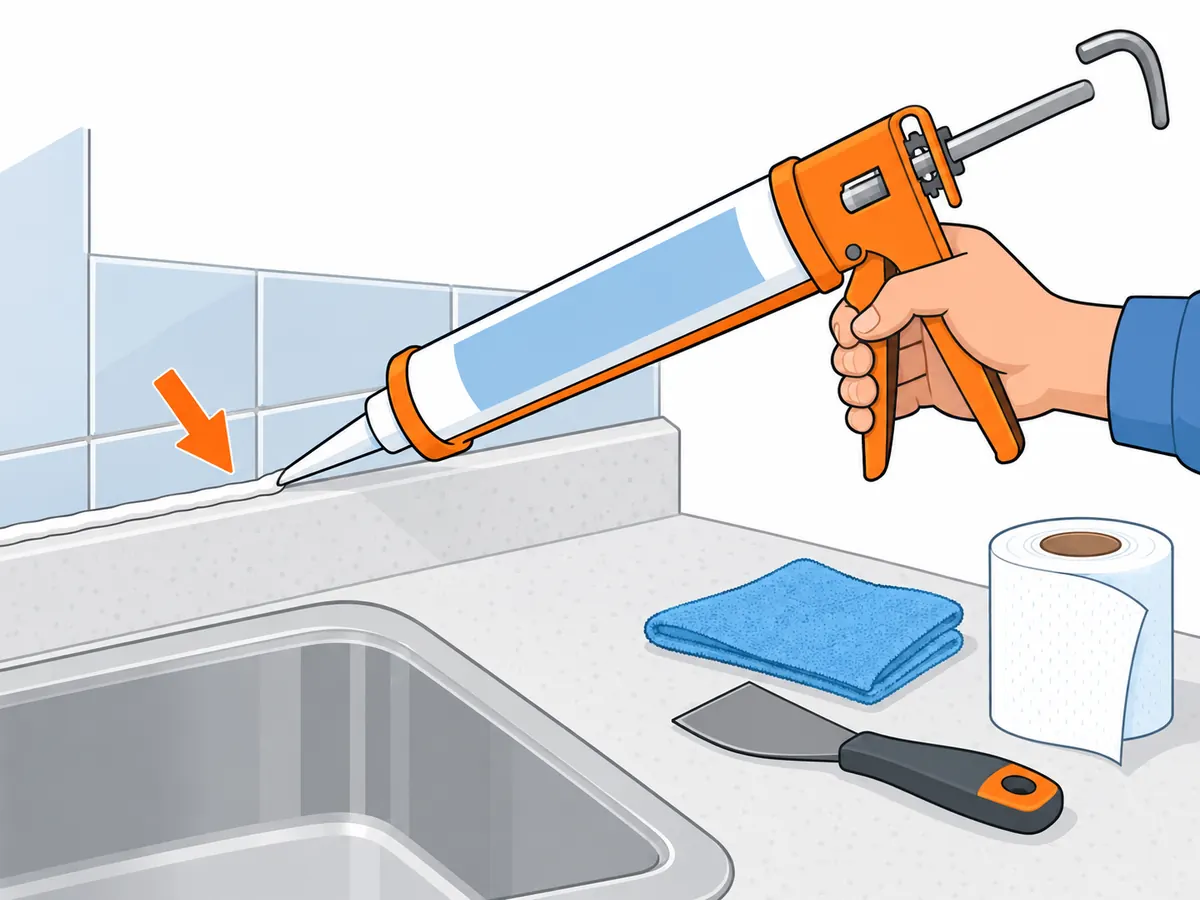
The gun matters less than the preparation. Clean and dry the joint, tape the edges and cut the nozzle opening small. Squeeze steadily and move at a constant speed. Release the pressure at the end so the bead stops. A drip-free gun does this for you. Smooth the bead with a damp fingertip or a tool in one pass, and pull the tape while the caulk is wet. Store a partly used tube with a nail in the tip, or a cap, so the caulk does not harden inside.
Which sealant goes in which gun
The tube matters as much as the gun. Silicone and latex caulk usually come in the standard 10 ounce cartridge that fits all these guns. Construction adhesive is thicker and needs more force, so the high-ratio gun helps. Foam sealants use a different tool. Use silicone for wet areas such as tubs and sinks, and paintable latex caulk for trim and baseboards. Read the label for cure time and temperature limits. Many sealants should not be applied in freezing weather, and some need a dry surface. If you are unsure which to buy, ask at the store with the surface type in mind.
A quick buying checklist
Check the cartridge size first. These guns are for the standard 10 ounce tube, so confirm yours is that size. Look at the thrust ratio and match it to the material. Check the plunger rod. A smooth rod usually feels easier to control, and a rod that retracts helps stop drips. Hold the gun in the store if you can, because grip comfort matters over a long bead. A built-in nozzle cutter and puncture tool save you from hunting for a knife and a nail.
Related guides
- Laser Level Comparison: Bosch GLL 30, Huepar 902CG and Huepar 3x360
- Voltage Tester vs Multimeter: Klein NCVT-3P, Fluke 1AC II and Klein MM400
- How to Caulk Around a Window to Stop Drafts and Water
- How to Fix a Gap in Caulk or Baseboards
- Cracked Caulk Around a Sink: When to Redo It and How
FAQ
What is a drip-free caulk gun?
One that releases pressure on the plunger when you stop squeezing.
Do I need a ratchet gun?
A smooth rod is quieter and often smoother, per the Newborn listing.
Can I use a hand gun for construction adhesive?
Yes, with a high thrust ratio.
Sources
Specifications as of November 2026, from these pages. Check them again for current figures.
More from this topic
- Cordless Impact Driver Comparison: DeWalt, Milwaukee, Ryobi: Compare a cordless impact driver from DeWalt, Milwaukee and Ryobi: stated torque, kit contents, pros and cons...
- Digital Hygrometer Comparison: A digital hygrometer shows indoor humidity so you can fight mold and condensation. We compare the ThermoPro...
- Electric Pressure Washer Comparison: Sun Joe and Greenworks: An electric pressure washer comparison of the Sun Joe SPX3000, Greenworks 2000 PSI and Ryobi RY142300 by...
- How to Clean Mirrors Without Streaks: Learn how to clean mirrors without streaks: the right cloth, solution and technique for a spotless, lint-free...
- How to Mix Epoxy So It Cures Hard Every Time: Learn how to mix epoxy: measure the ratio exactly, mix thoroughly without bubbles, and know your working time...
 Tools and BasicsCordless Impact Driver Comparison: DeWalt, Milwaukee, RyobiCompare a cordless impact driver from DeWalt, Milwaukee and Ryobi: stated torque, kit contents, pros and cons as of Nov 2026.
 Tools and BasicsDigital Hygrometer ComparisonA digital hygrometer shows indoor humidity so you can fight mold and condensation. We compare the ThermoPro TP50, AcuRite 00613 and AcuRite 01083M.
 Tools and BasicsElectric Pressure Washer Comparison: Sun Joe and GreenworksAn electric pressure washer comparison of the Sun Joe SPX3000, Greenworks 2000 PSI and Ryobi RY142300 by stated PSI, GPM, features and price as of Nov 2026.
 Tools and BasicsHow to Clean Mirrors Without StreaksLearn how to clean mirrors without streaks: the right cloth, solution and technique for a spotless, lint-free shine.
 Tools and BasicsHow to Mix Epoxy So It Cures Hard Every TimeLearn how to mix epoxy: measure the ratio exactly, mix thoroughly without bubbles, and know your working time before it sets.