
Digital Hygrometer Comparison
Part of: Tools and everyday fixes
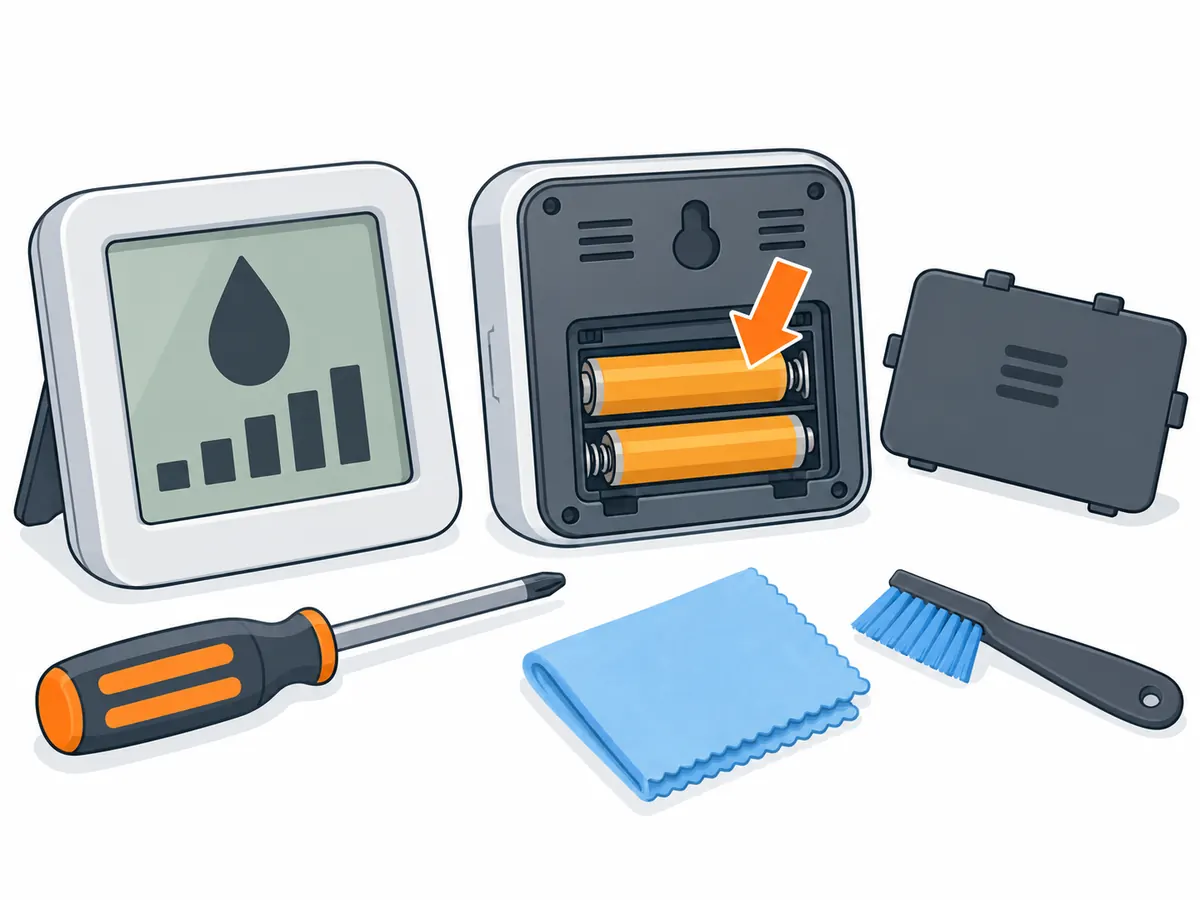
In this guide
If you have window condensation, musty smells or peeling paint in a bathroom, you need a number, not a guess. A digital hygrometer reads the relative humidity in a room. Most homes aim for roughly 30 to 50 percent in winter. A cheap hygrometer will tell you if a dehumidifier or a better fan would help.
This guide is part of our wider guide to heating, cooling and air quality.
How we compared these. We did not test these tools ourselves. This comparison is based on manufacturer specifications, retailer product pages and published reviews. We do not list prices because they change often and vary by store, kit and sale. Check the current price before you buy. We do not use affiliate links.
At a glance
| ThermoPro TP50 | AcuRite 00613 | AcuRite 01083M | |
|---|---|---|---|
| Reads | Temperature and humidity | Temperature and humidity, high/low records, humidity level icon | Humidity and temperature, comfort scale |
| Stated detail | Operating humidity 10 to 99 percent, AAA battery, tabletop | Wall mount, stand or magnet | 3 x 2.5 in., backlight (per listing) |
The models, one by one
ThermoPro TP50
A small tabletop unit. The Amazon listing gives an operating humidity of 10 to 99 percent and an AAA battery. It has a very large review count.
AcuRite 00613
The AcuRite page says it shows relative humidity and temperature in F or C, has a humidity level icon, records daily highs and lows, and can be mounted, stood up or stuck on a metal surface.
AcuRite 01083M
A small unit with a comfort scale.
How to choose
- One in the bathroom, one in the bedroom gives the best picture.
- Compare two units side by side for a day. Cheap hygrometers can differ by several percent.
- Place it away from windows, heat vents and the shower to get a typical reading.
- Use the reading to decide whether you need a fan, a dehumidifier or a leak repair.
What to do with the number
If the reading is over 50 percent in winter, look for causes. Showers, cooking, drying clothes indoors and a damp basement all raise humidity. Run fans, vent the dryer outside and fix leaks. A dehumidifier can help in a damp room. If the reading is very low, say under 25 percent, the air may feel dry and static can build up. A humidifier can help, but keep it clean and do not push the level above the range that causes condensation on windows. Check the readings over several days instead of one hour.
Placement and checking accuracy
Place the hygrometer at about chest height, away from windows, vents and the shower. Give it at least 30 minutes after you move it to a new room, since sensors need time to adjust. To check two units against each other, place them side by side overnight. If they differ by a few percent, that is normal for low-cost sensors. If they differ by a lot, one may be off. Replace batteries once a year, since a weak battery can cause odd readings. A single unit tells you about one room. Basements, bathrooms and bedrooms can differ, so move it around.
A quick buying checklist
Before you buy, decide where it will sit. A tabletop unit suits a desk or shelf, while a wall or magnet model is better in a basement or utility room. Look at the display size, since small digits are hard to read from across a room. Check whether it shows highs and lows, which is useful for seeing a pattern overnight. Look at the battery type and how easy it is to replace. If you want to watch humidity from your phone, a smart sensor is a different product at a different price, and it is not covered here.
Related guides
- Caulk Gun Comparison: Red Devil 3985, Newborn 10:1, Red Devil 3935 and 3989
- Wet-Dry Vac Comparison: Shop-Vac, Ridgid RT0600 and Craftsman 6 Gallon
- How to Control Basement Humidity and Keep the Air Dry
- How to Get Rid of a Musty Basement Smell by Fixing the Cause
- How to Clean Air Vents and Registers Without Hiring a Duct Cleaner
- Laser Level Comparison
FAQ
What humidity should I keep indoors?
Many sources suggest 30 to 50 percent. Lower in very cold weather to reduce window condensation.
Are cheap hygrometers accurate?
They are good enough to see a trend. Compare two to check.
Do I need a smart one?
Not for basic use.
Sources
Specifications as of November 2026, from these pages. Check them again for current figures.
More from this topic
- How to Clean a Humidifier to Prevent Mold: Learn how to clean a humidifier: empty the tank, descale with vinegar, scrub the base, rinse well, and dry it...
- How to Test Home Humidity With or Without a Hygrometer: Learn how to test home humidity: use a hygrometer, read the signs your house gives you, and keep levels in...
- How to Use a Humidifier Safely and Keep It Clean: Learn how to use a humidifier safely: set the right level, clean it before mold grows, and place it where it...
- Caulk Gun Comparison: Red Devil and Newborn Models: Compare four hand caulk guns by thrust ratio and frame as of Nov 2026: Red Devil 3985, Newborn drip-free...
- Cordless Impact Driver Comparison: DeWalt, Milwaukee, Ryobi: Compare a cordless impact driver from DeWalt, Milwaukee and Ryobi: stated torque, kit contents, pros and cons...
 KitchenHow to Clean a Humidifier to Prevent MoldLearn how to clean a humidifier: empty the tank, descale with vinegar, scrub the base, rinse well, and dry it so it does not spread mold or minerals.
 Heating and CoolingHow to Test Home Humidity With or Without a HygrometerLearn how to test home humidity: use a hygrometer, read the signs your house gives you, and keep levels in the healthy 30 to 50 percent range.
 Heating and CoolingHow to Use a Humidifier Safely and Keep It CleanLearn how to use a humidifier safely: set the right level, clean it before mold grows, and place it where it helps instead of harms.
 Tools and BasicsCaulk Gun Comparison: Red Devil and Newborn ModelsCompare four hand caulk guns by thrust ratio and frame as of Nov 2026: Red Devil 3985, Newborn drip-free 10:1, Red Devil 3935 and Red Devil 3989.
 Tools and BasicsCordless Impact Driver Comparison: DeWalt, Milwaukee, RyobiCompare a cordless impact driver from DeWalt, Milwaukee and Ryobi: stated torque, kit contents, pros and cons as of Nov 2026.