
Gutters, Drainage and Water Around the House
Part of: Outdoors and garage
- Difficulty
- Easy to moderate
- Time
- 30 minutes to half a day
- Tools
- Ladder, gloves, bucket, trowel, hose, downspout extension, adjustable wrench, plumber's tape
- Call a pro if
- Gutters are pulling away from the fascia, water is entering the basement or crawl space, the roof is leaking, or the work needs a ladder above the first story.
In this guide
- Ladder safety
Water is the most patient thing that attacks a house. It does not need a storm; it needs a slope, a clog or a gap, and a few seasons. Almost every wet basement, rotted fascia board and stained ceiling started as water leaving a gutter in the wrong place. This page covers the outdoor water jobs that keep it moving away from the walls.
Gutters and downspouts
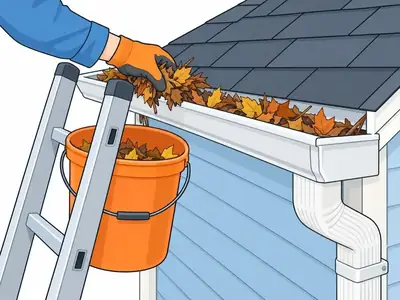
Cleaning gutters is the job that prevents most of the damage, and it is also the job most often postponed until a ceiling stains. Do it twice a year, after the leaves fall and again in spring. Scoop by hand or with a trowel, flush the downspouts with a hose, and check that water actually leaves the end. Wear gloves: the debris is sharp, and a wasp nest under a gutter guard is a common surprise. Work along the gutter rather than reaching, and never put your hand into a downspout opening you cannot see into.
A gutter that sags holds water, and standing water finds the seams. Fixing a sag is a matter of hangers and slope: gutters need to fall about an inch every ten to fifteen feet toward the downspout. A leaking seam is a cleaning-and-sealer job, and it only works if the seam is dry.
The end of the downspout is where most houses get it wrong. A downspout that discharges against the foundation puts every gallon back where you do not want it, and it takes only one wet season for that water to find a crack. An extension and a splash block move it two or three feet away; a longer run or a buried line moves it further.
Moving water away from the foundation
The ground should slope away from the house. Where it does not, water pools, and the basement or crawl space takes it. Correcting the grade is cheap and unglamorous and does more than any caulk.
An outdoor drain or catch basin that is clogged backs water up against the house. Clearing it and keeping the grate clear is the maintenance. A rain barrel captures downspout water for the garden, but only if it has an overflow that leads away from the foundation.
If the roof is leaking, a temporary repair buys time until a roofer can get there. It is not a fix, and the sooner it is properly repaired the better.
Outdoor faucets and hoses
A dripping outdoor faucet wastes water quietly and can freeze and split in winter. Replacing the washer or the whole spigot is a small job; the important part is shutting the water off inside first.
A vacuum breaker on the spigot prevents backflow, and when it leaks it sprays every time you use the hose. Replacing it is a two-minute job. A garden hose that leaks at the coupling is usually a perished washer, not a new hose. In cold climates, a hose bib cover and a proper winter shutdown prevent the split that floods a wall in spring.
Sprinklers and irrigation
A sprinkler head that will not pop up is usually dirt, a broken riser or low pressure at that zone. A valve that leaks or stays open keeps a zone running and can waterlog a lawn. A broken pipe shows as a soft, soggy patch or a fountain when the zone runs.
Drip irrigation is the least wasteful way to water beds, and the setup is mostly about a filter, a pressure regulator and emitters that match the plants. Set a hose reel properly and the hose stops lying across the path.
When to stop and call a pro
Call if gutters are pulling away from the fascia, if water is getting into the basement or crawl space despite your best efforts, if the roof is leaking, or if the work needs a ladder above the first story. Roof work and anything involving fascia or soffit repair is worth doing once, properly.
FAQ
How often should gutters be cleaned? Twice a year in most climates, and more often if you have trees over the roof. Check after any major storm.
Why does water come out of the gutter behind the fascia? The gutter has pulled away, the hangers have failed, or the flashing is wrong. That is a repair, not a cleaning.
Is a rain barrel worth it? For garden watering, yes, if you have an overflow that runs away from the house. Standing water against a foundation is worse than no barrel.
Can I extend a downspout underground? Yes, with the right pipe and a slope, ending at a pop-up emitter or a dry well. Do not bury a line that has nowhere to drain.
Related guides
- How to Clean Gutters Safely From the Ground or a Ladder
- Downspout Drainage: How to Direct Water Away From Your House
- Downspout Drainage: How to Direct Water Away
- How to Fix a Dripping Outdoor Faucet
- How to Clear a Clogged Outdoor Drain or Catch Basin
- How to Stop Water Pooling Against a Foundation
More from this topic
- Garage, Decks, Fences and Yard Care: What to Fix and When: Yard care: a garage door that will not close, a sagging gate, a wobbly deck railing, a patchy lawn or weeds...
- Water Pressure, Pipes and Sump Pumps: What to Check: Water pressure: low pressure, banging pipes, condensation, frozen lines or a sump pump that will not run....
- How to Clean Gutters Safely From the Ground or a Ladder: Learn how to clean gutters safely: set up a ladder correctly, scoop out debris, flush the downspouts and...
- Heating, Cooling and Air Quality: Checks Before Service: Air quality: an AC that will not cool, a radiator that stays cold, a thermostat that is dead, drafts, attic...
- Kitchen Cabinets, Countertops and Storage: Fix and Organize: Kitchen cabinets: cabinet doors that sag or will not close, drawers that stick, chipped laminate, a wobbly...
 Garage and OutdoorsGarage, Decks, Fences and Yard Care: What to Fix and WhenYard care: a garage door that will not close, a sagging gate, a wobbly deck railing, a patchy lawn or weeds in the driveway. Steps and safety tips included.
 PlumbingWater Pressure, Pipes and Sump Pumps: What to CheckWater pressure: low pressure, banging pipes, condensation, frozen lines or a sump pump that will not run. Includes the tools you need and when to call a pro.
 Garage and OutdoorsHow to Clean Gutters Safely From the Ground or a LadderLearn how to clean gutters safely: set up a ladder correctly, scoop out debris, flush the downspouts and check for leaks and sagging gutters.Heating and CoolingHeating, Cooling and Air Quality: Checks Before ServiceAir quality: an AC that will not cool, a radiator that stays cold, a thermostat that is dead, drafts, attic insulation and humidity.
 KitchenKitchen Cabinets, Countertops and Storage: Fix and OrganizeKitchen cabinets: cabinet doors that sag or will not close, drawers that stick, chipped laminate, a wobbly faucet or a kitchen that has run out of storage.