
Power Strip Overload: How to Spot It
Part of: Electrical safety
- Difficulty
- Easy
- Time
- 10 to 20 minutes
- Tools
- Your devices, a flashlight, a calculator, the labels on the strip and on each device
- Call a pro if
- an outlet or plug is hot or discolored, the breaker trips often when you use the strip, or you smell burning
In this guide
- Power off first
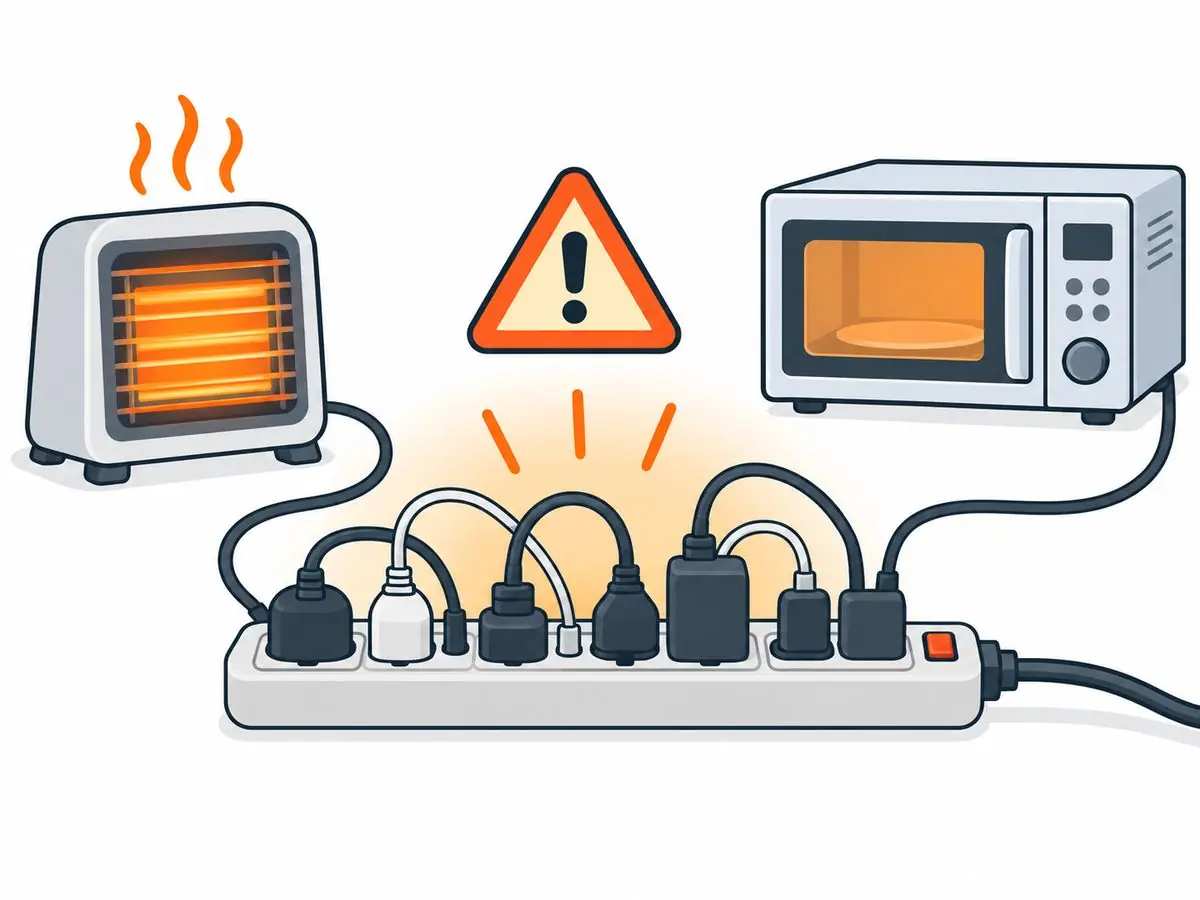
A power strip makes one outlet look like six, but the outlet behind it can still deliver only so much power. A power strip overload can heat the cord, the plug and the outlet. Here is how to spot it early and fix it with a few simple changes.
This guide is part of our wider guide to electrical problems and safety.
What overload means
Every circuit has a limit. A standard home circuit with a 15-amp breaker can supply about 1,800 watts, and a 20-amp circuit about 2,400 watts. Safe continuous use is lower, around 80 percent of that. A power strip also has its own rating, often 1,875 watts for a 15-amp strip. If the devices plugged in draw more than the strip or the circuit can supply, the wires heat up.
Warning signs
- The strip or plug feels warm or hot.
- The plastic smells like burning or shows brown marks.
- Lights dim when a device turns on.
- The breaker trips.
- The strip's own breaker or switch pops.
- Devices turn off at random.
If you notice heat, a burning smell or melted plastic, unplug the strip right away, and replace it.
Step by step: check your load
1. Find the rating on the strip. It is on the label, in watts or amps.
2. Read each device's label. Look for watts. If only amps and volts are listed, multiply them: amps times 120 volts equals watts.
3. Add them up. List all devices on the strip and total the wattage.
4. Compare. The total should stay well below the strip's rating and below about 80 percent of the circuit's limit when other things on the same circuit are also in use.
5. Find the high-draw devices. Space heaters, microwaves, toasters, hair dryers, air conditioners and kettles use a lot. Plug these directly into a wall outlet.
6. Do not chain strips. Never plug one power strip into another.
7. Move devices. Spread them across different outlets and, if possible, different circuits.
8. Replace old strips. Choose a strip with a safety listing mark and a built-in circuit breaker.
Good habits
- Use a surge protector for computers and TVs, but check that it has a safety listing.
- Do not put a strip under a rug or behind heavy furniture.
- Unplug the strip when you leave for a long trip.
- Use a strip with a short cord, and do not run it across a walkway.
If you need more outlets in one place, have an electrician add them. How to replace an outlet shows what to look for in a worn outlet, and Extension cord safety for homeowners covers cords.
Choosing a better power strip
A good strip has a listing mark from a recognized safety lab, a built-in circuit breaker, a thick cord and a rating that matches your needs. Avoid very cheap strips with thin cords. Some strips have a surge protection rating in joules. A higher number means more protection, but it does not raise the load limit. Replace surge protectors every few years, or after a big surge, because the protection wears out.
Where to put the strip
Put the strip where air can move around it, not under a blanket, inside a closed cabinet or behind a heavy couch. Keep it away from water, such as under a sink or near a plant. Do not run the cord under carpet, where damage cannot be seen and heat cannot escape. Check the plug and the cord every few months for heat marks.
Related guides
- How to Secure Sliding Doors and Windows Against Break-Ins
- Replace Outlet Cover Plate (and Switch Plates)
- How to Install a Dimmer Switch
- How to Replace a Light Switch
FAQ
Can I plug a space heater into a power strip?
No. Plug it straight into a wall outlet.
How many things can I plug in?
It depends on their combined watts, not how many sockets the strip has.
Is a surge protector the same as a power strip?
A surge protector adds protection against voltage spikes, but it has the same load limit.
Do power strips wear out?
Yes. Replace them when the switch is worn, the cord is damaged or the surge protection indicator is off.
More from this topic
- How to Protect Electronics From Power Surges: Learn how to protect electronics from power surges: use surge protectors correctly, unplug during storms,...
- Extension Cord Safety for Homeowners: Extension cord safety for homeowners: choose the right gauge and length, avoid overload and know when to stop...
- How to Babyproof Electrical Outlets and Cords: Babyproof electrical outlets and cords with tamper-resistant receptacles, sliding outlet covers, cord...
- How to Make a Home Fire Escape Plan (and Practice It): Make a home fire escape plan with two ways out of every room, a meeting spot, practiced drills, and working...
- How to Use a Generator Safely During a Power Outage: Learn how to use a generator safely: run it outdoors far from the home, keep CO alarms working, fuel it...
 SafetyExtension Cord Safety for HomeownersExtension cord safety for homeowners: choose the right gauge and length, avoid overload and know when to stop using a cord. Simple rules to prevent fires.SafetyHow to Babyproof Electrical Outlets and CordsBabyproof electrical outlets and cords with tamper-resistant receptacles, sliding outlet covers, cord shorteners and concealment, and smart furniture placement.
 SafetyHow to Make a Home Fire Escape Plan (and Practice It)Make a home fire escape plan with two ways out of every room, a meeting spot, practiced drills, and working smoke alarms on every level.SafetyHow to Use a Generator Safely During a Power OutageLearn how to use a generator safely: run it outdoors far from the home, keep CO alarms working, fuel it safely and never backfeed power into your house.