
Dishwasher Not Draining After Replacing Garbage Disposal
Part of: Appliances
- Difficulty
- Easy to medium
- Time
- 20 minutes to 1 hour
- Tools
- Towels, shallow pan or cup, sponge, screwdriver, pliers, flashlight, bucket, old toothbrush
- Call a pro if
- the drain pump hums but does not move water, the hose is damaged inside the wall or the control board is at fault
In this guide
- Power off first
- Wear protection
- Chemical safety
You open the dishwasher after a cycle and find a pool of dirty water at the bottom. A dishwasher not draining is a common problem, and most of the time the cause is a clog you can clear yourself. This guide goes from the easiest checks to the harder ones.
This guide is part of our wider guide to appliance problems.
Start with the simple checks
1. Run the garbage disposal if you have one, with the faucet running. If the disposal is full of food, the dishwasher cannot drain into it.
2. Check the sink. If the sink is clogged, the dishwasher water backs up. See Kitchen sink clogged, double basin: how to fix.
3. Check the cycle. Make sure the cycle is finished. Some cycles pause with water in the tub.
4. Remove standing water. Scoop it out with a cup and a sponge.
Remove standing water first
Use a cup and a sponge to scoop water into a bucket. Dry the floor of the dishwasher with towels.
Clean the filter
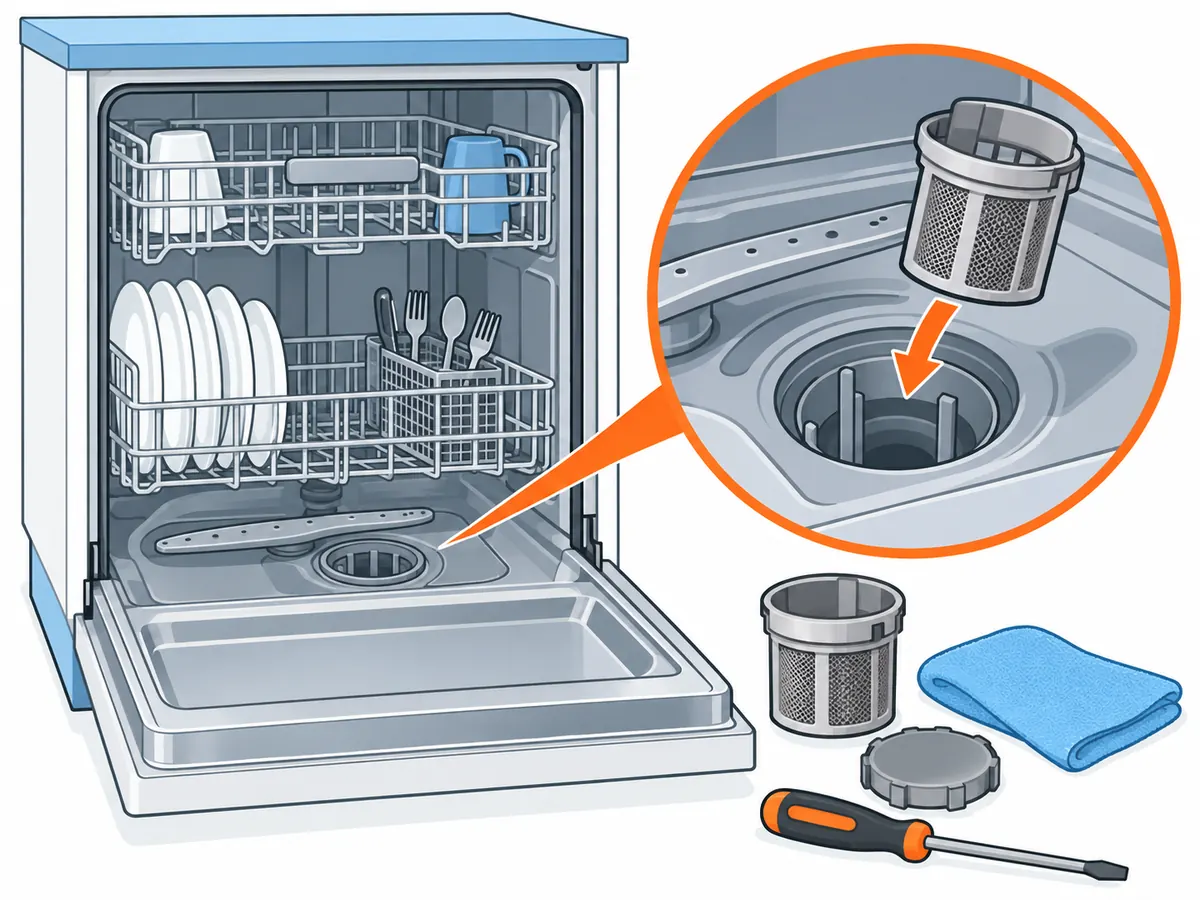
The filter at the bottom of the tub catches food. When it is clogged, water cannot drain.
1. Remove the lower rack.
2. Twist and lift out the filter, following your manual. There may be a coarse and a fine filter.
3. Rinse them in warm water. Brush gently with an old toothbrush.
4. Check the area under the filter for glass, bones or labels.
5. Replace the filter and make sure it locks in.
Check the drain hose
1. Turn off the power at the breaker. See How to find your electrical panel and label breakers.
2. Open the cabinet under the sink. Find the drain hose from the dishwasher to the disposal or the sink drain pipe.
3. Check for kinks and bends. Straighten the hose.
4. Check the connection at the disposal or the drain. If you installed a new disposal recently, see the section below on the knockout plug. See also How to replace a garbage disposal.
5. Remove the hose and check for a clog. Put a bucket under the end. Blow or flush through it to clear the clog. Reconnect it.
If you just replaced the garbage disposal
A dishwasher that stops draining right after a new disposal goes in has a specific cause, and it is not the dishwasher.
1. Know what the knockout plug is. Every new disposal ships with a small plastic plug pushed into the dishwasher inlet on the side of the unit. It is there so the disposal can be sold for a sink with no dishwasher. It has to be removed before the dishwasher drain hose is connected.
2. Know what it does when it stays in. The dishwasher pumps water out through that hose into a dead end. The water has nowhere to go, so it backs up into the dishwasher, and often into the sink as well. The dishwasher then reports a drain error or leaves standing water in the tub.
3. Check before you take anything apart. Pull the dishwasher's power at the breaker, then look at the inlet where the drain hose meets the disposal. If the hose is connected and the plug was never knocked out, that is your answer.
4. Remove the plug properly. Disconnect the drain hose at the inlet, push the plug through into the disposal chamber with a screwdriver or the tool that came with the unit, then reach in with pliers and take it out. Leaving it loose inside the disposal is how you turn a drain problem into a jammed disposal.
5. Reconnect and check every joint. Refit the hose, tighten the clamp, and look at the hose adapter and the elbow and trap joints as well. InSinkErator's own troubleshooting list puts the knockout plug first, then the clamps, the hose adapter and the trap joint, and all four leak in the same place.
6. Run a test cycle. Start the dishwasher empty, let it run for a few minutes into the drain, and watch the inlet under the sink with a flashlight and a paper towel under the joint.
7. If it still backs up, the plug was not the only problem. Go back to the drain hose and high loop checks above, then the drain pump.
Safety: Cut the power at the breaker before you reach under the sink, and never put a hand into the disposal chamber while the unit is plugged in. The grinding chamber has sharp edges even when it is off.
Check the air gap or high loop
Many homes have an air gap, a small cylinder on the sink or counter. If it is clogged, the dishwasher cannot drain. Lift off the cap and clean out the debris. Other homes have a high loop, where the hose rises to the underside of the counter before it goes down to the drain. This stops dirty water from running back into the dishwasher. Make sure the loop is high.
Check the drain pump
The drain pump pushes water out. If the filter and hose are clear, and the water is still there, listen to the pump when the drain cycle starts. A hum with no water movement means there may be a jam, such as a piece of glass or a broken part. Access varies by model. A repair person can check it.
Signs that point to each cause
Water in the tub with a smell of rotten food points to a clogged filter. Water that drains slowly points to a partial clog. Water that backs up into the sink points to a sink or disposal clog. Gurgling sounds point to a drain vent problem. A silent machine with no pump noise may have a failed pump, a bad control board or a door switch problem. A machine that stops and shows an error code needs the manual. Check the model.
Clean the machine
Start an empty hot cycle using a dishwasher cleaner, or set a cup of white vinegar upright on the top rack. Wipe the door and the gasket. See Dishwasher smells: how to get rid of the odor. Use the right amount of detergent. See also Dishwasher not cleaning dishes: what to check.
Prevention
Scrape plates before loading. Clean the filter once a month. Run the disposal before the dishwasher. Run hot water at the sink before a cycle. Do not overload the machine. Check the hose each year.
A test after the fix
Pour a quart of water into the bottom of the tub and run the drain cycle alone, if your machine has one. Watch that the water leaves within a minute or two. Then run a short wash cycle with a few dishes and check again at the end. If the water is still there, check the hose and the air gap once more, and note any sounds from the pump, since they help a service person find the fault.
Related guides
- How to Clean a Dishwasher Filter to Stop Smells and Cloudy Dishes
- Dishwasher Door Latch Not Closing: How to Fix It
- Dishwasher Will Not Start: What to Check First
- Dishwasher Leaking From the Door: Causes and Fixes
FAQ
Why is there water in my dishwasher after a cycle?
A clogged filter, hose, disposal or sink drain is the usual cause.
Do I need to clean the filter?
Yes, about once a month.
What is an air gap?
A fitting that stops dirty water from flowing back.
Can I use vinegar in the dishwasher?
Yes, it helps to remove buildup.
More from this topic
- How to Unclog a Dishwasher Drain Hose Step by Step: Learn how to unclog a dishwasher drain hose: unplug the unit, find the hose, disconnect it, clear the...
- Washing Machine Not Draining: What to Check: Washing machine not draining? Check the drain hose, the pump filter and the standpipe. Safe steps, tools and...
- Garbage Disposal Backs Up Into the Other Sink: Fixes: When a garbage disposal backs up into the other sink, the clog is past the disposal in the shared drain....
- How to Clean a Washing Machine Drain Pump Filter: Learn how to clean a washing machine drain pump filter: find the panel, drain the water, clear lint and...
- How to Install a Garbage Disposal Under a Kitchen Sink: Learn how to install a garbage disposal: check the outlet, fit the sink flange and mounting ring, hang the...
 KitchenHow to Unclog a Dishwasher Drain Hose Step by StepLearn how to unclog a dishwasher drain hose: unplug the unit, find the hose, disconnect it, clear the blockage and reconnect it to stop standing water.
 KitchenWashing Machine Not Draining: What to CheckWashing machine not draining? Check the drain hose, the pump filter and the standpipe. Safe steps, tools and when to call a repair tech.
 KitchenGarbage Disposal Backs Up Into the Other Sink: FixesWhen a garbage disposal backs up into the other sink, the clog is past the disposal in the shared drain. Clear it in this order, safely.
 KitchenHow to Clean a Washing Machine Drain Pump FilterLearn how to clean a washing machine drain pump filter: find the panel, drain the water, clear lint and coins, and refit the filter correctly.
 KitchenHow to Install a Garbage Disposal Under a Kitchen SinkLearn how to install a garbage disposal: check the outlet, fit the sink flange and mounting ring, hang the unit, connect the drain and test for leaks.