
How to Install a Bypass Closet Door
Part of: Floors, walls and doors
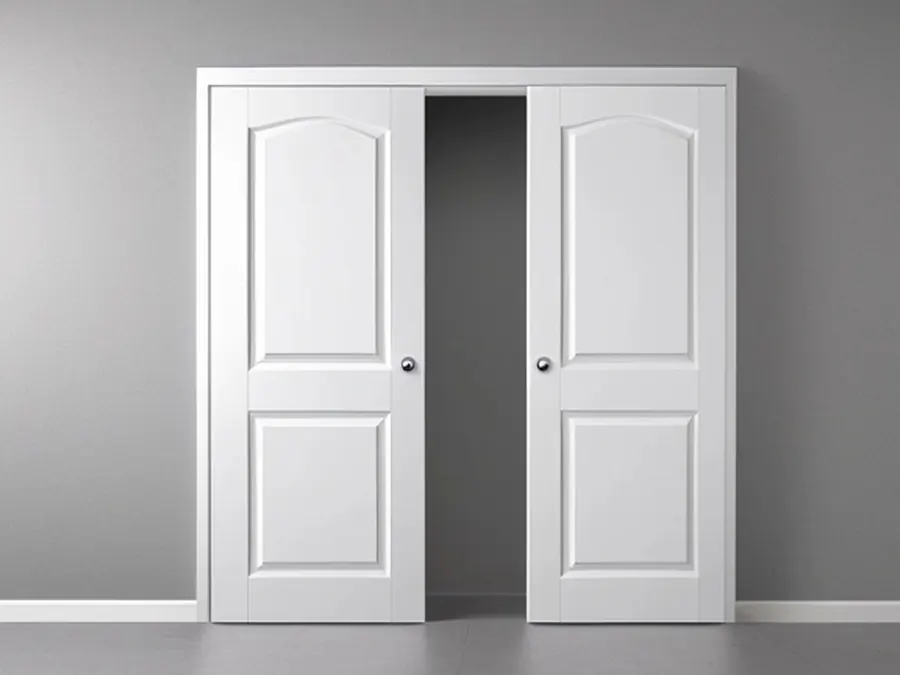
- Difficulty
- Easy
- Time
- 2 to 3 hours
- Tools
- tape measure, pencil, level, drill, screwdriver, hacksaw, utility knife, stud finder, shims
- Call a pro if
- The closet opening is out of square by more than half an inch, the header is sagging, or the opening has no framing to hold a track.
In this guide
- Measure the opening in three places
- Check the header for level and framing
- Choose the panels and the overlap
- Install the top track
- Fit the rollers to the panels
- Fit the bottom guides
- Hang the back panel first
- Hang the front panel
- Adjust height and clearance
- Fit the pulls and finish
- Common mistakes
- Related guides
- FAQ
- When to call a pro
- Wear protection
Knowing how to install a bypass closet door is a good weekend job that transforms a closet. The hardware is simple: a top track, a bottom guide, and four rollers. Most problems come from an unlevel track or from cutting the panels before checking the opening for square.
This guide covers a standard two panel bypass set in a framed opening with a finished header. The same steps apply to three and four panel sets, with the tracks stacked in the order the maker specifies.
1. Measure the opening in three places
Measure the width at the top, the middle, and the bottom, and the height on both sides. Openings are rarely square, and the smallest of each pair is the number that matters. Write the numbers down and use them for the panel size rather than the size on the box.
2. Check the header for level and framing
Set a level on the header. If it slopes, the track will slope with it and the doors will creep open. Find the studs above the opening so you know where the track screws will bite. A sagging header needs repair before a track goes up.
3. Choose the panels and the overlap
Panels are sized so that each one covers half the opening plus the overlap. With a 60 inch opening and a 2 inch overlap, each panel is about 31 inches wide. Panels that are too narrow leave a gap in the middle; too wide and they will not clear each other.
4. Install the top track
Center the track over the opening and check it with a level. Screw it into the header framing at every hole, using the screws supplied. If the track has two channels, the rear channel takes the back panel and the front channel takes the front panel. Shim the track if the header is out of level rather than forcing it.
5. Fit the rollers to the panels
Turn each panel face down on a padded surface and fit the rollers into the top edge at the maker's spacing. Most panels have predrilled holes; if not, drill pilot holes so the panel does not split. Set the adjustment screw to the middle of its range.
6. Fit the bottom guides
Screw the bottom guide to the floor or the sill, centered under the track, in the position the instructions show for each panel. The guide keeps the panels from swinging and is what stops a bypass door from rubbing the jamb. On carpet, use a guide with a longer fin.
7. Hang the back panel first
Lift the rear panel and set its rollers into the rear channel, then let it hang. Check that it hangs plumb with a level on the face and that the bottom sits in its guide. If it is out of plumb, adjust the roller on the low side.
8. Hang the front panel
Set the front panel into the front channel the same way. Slide both panels to check that they pass each other without touching, and that each one covers its half of the opening. The front panel should overlap the back one by 2 to 3 inches in the middle.
9. Adjust height and clearance
Turn the roller adjustment screws to set the gap at the floor. A quarter inch is about right for carpet and an eighth for hard floors. Check that the panels clear the head jamb and that the bottom guide does not rub. Work the doors back and forth several times to make sure nothing binds.
10. Fit the pulls and finish
Add pulls at a comfortable height on the leading edges, or fit a finger pull if the panels are flush. Touch up any scratched paint. If the closet has no light, a battery powered strip light inside makes the doors worth opening.
Common mistakes
- Cutting panels to the width on the box instead of the smallest measured opening.
- Mounting the track without checking level, so the doors slide open on their own.
- Forgetting the bottom guides, so the panels swing and rub.
- Screwing the track into drywall instead of framing.
- Setting both panels in the same channel, so they cannot pass each other.
- Leaving no floor clearance, so the panels drag on carpet.
Related guides
- How to Install a Barn Door
- How to Install a Mail Slot
- Sliding Door Off Track or Hard to Slide: How to Fix It
- How to Adjust a Bifold Door
- How to Install a Storm Door
- How to Fix a Storm Door That Slams or Will Not Close
FAQ
How much should bypass doors overlap?
About 2 to 3 inches in the middle. Less leaves a gap you can see through; more wastes opening width.
Do bypass closet doors need a bottom track?
They need a bottom guide, not a full track. The guide keeps the panels aligned while the top track carries the weight.
Can I install bypass doors on a carpeted floor?
Yes, with a guide made for carpet and a little more floor clearance. Adjust the rollers so the panels clear the pile.
Why do my bypass doors keep sliding open?
The top track is not level. Re-level it rather than adding a latch.
Can I replace just one panel?
Yes, if you can find a matching size and finish. Measure the old panel, including the height of the rollers.
More from this topic
- How to Install a Barn Door: How to install a barn door: mount the track into studs, get the door square and level, set the rollers, and...
- How to Install a Bifold Door: How to install a bifold door square and smooth: set the track level, anchor the pivot side, hang the panels,...
- How to Install a Mail Slot: How to install a mail slot in a front door or wall: cut the opening clean, fit the sleeve, seal it, and keep...
- How to Install a Screen Door: How to install a screen door so it closes square: fit the frame to the opening, hang it on the hinges, and...
- How to Install Window Blinds: How to install window blinds level and centered: measure inside or outside mount, find the framing, and set...
 Doors and WindowsHow to Install a Barn DoorHow to install a barn door: mount the track into studs, get the door square and level, set the rollers, and fit a floor guide that works.
 Doors and WindowsHow to Install a Bifold DoorHow to install a bifold door square and smooth: set the track level, anchor the pivot side, hang the panels, and adjust the gap.
 Doors and WindowsHow to Install a Mail SlotHow to install a mail slot in a front door or wall: cut the opening clean, fit the sleeve, seal it, and keep the flap swinging freely.
 Doors and WindowsHow to Install a Screen DoorHow to install a screen door so it closes square: fit the frame to the opening, hang it on the hinges, and set the closer and latch.
 Doors and WindowsHow to Install Window BlindsHow to install window blinds level and centered: measure inside or outside mount, find the framing, and set the brackets square.