
Oven Not Heating but Stovetop Works: What to Check
Part of: Appliances
- Difficulty
- Easy
- Time
- 20 to 45 minutes
- Tools
- Flashlight, screwdriver, multimeter (optional), your model number
- Call a pro if
- The oven is gas, the element looks fine but the oven still stays cold, or the control board or wiring looks burned. A gas smell of any kind means stop and call.
In this guide
- Check the setting before anything else
- Look at the bake element
- Test the element with a meter
- Check the broil element and the oven light
- Think about what changed recently
- Gas ovens are a different job
- Know when it is the control board
- Check the door seal while you are there
- Quick tips
- When to stop and call a pro
- Common mistakes
- Related guides
- FAQ
- Sources
- Power off first
- Gas safety
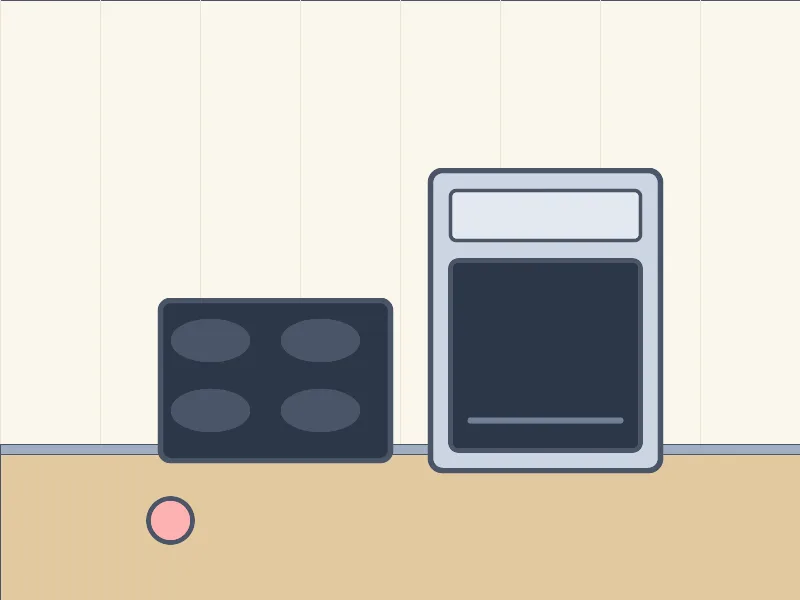
Oven not heating but stovetop works? The stovetop burners and the oven are separate circuits inside the same box. Burners that still glow tell you the range has power, not that the oven does. That narrows the problem to a short list, and the first two items on it cost nothing to check.
1. Check the setting before anything else
1. Make sure the oven is set to Bake, not to Broil, Warm, Proof or a timed setting that has not started.
2. On a range with a mechanical self-clean latch, check that the latch is fully unlocked. A latched door keeps the oven from heating (GE).
3. If the knobs were pulled off for cleaning, check that each one went back on the right shaft. A temperature knob on the function shaft gives you an oven that does nothing.
4. If the oven is new, or the power was just restored, give it a few minutes.
2. Look at the bake element
1. Cut the breaker and unplug the range.
2. Open the door and look at the lower element across the floor of the oven.
3. Look for a blister, a crack, a break, or a section sagging away from its mounts. A cracked bake element is the most common reason an electric oven stops heating while the burners still work.
4. A broken element is replaced as a unit. See How to replace an oven heating element.
5. If the element looks intact, do not assume it is fine. An element can fail inside and look perfect.
3. Test the element with a meter
1. With the power off and the range unplugged, disconnect the element's two leads.
2. Set a multimeter to resistance and measure across the element terminals.
3. A healthy element reads a low resistance, typically somewhere between 10 and 60 ohms depending on the model. An open circuit, or no reading at all, means the element has failed.
4. If you do not own a meter, this is the point to weigh a service call against the price of a part.
4. Check the broil element and the oven light
1. Turn the oven to Broil for a minute and watch the top element.
2. If the broil element glows but the bake element does not, the problem is the bake circuit: the element or its wiring.
3. If neither element works and the oven light stays dark, the oven may have lost one leg of its 240 volt supply. That is a breaker or wiring problem, not an element.
4. Check the panel for a tripped double pole breaker and reset it once.
5. Think about what changed recently
1. A self-clean cycle runs far hotter than cooking, and it is the most common trigger for a failed element or a blown thermal fuse.
2. If the oven died right after a self-clean, suspect the element, the thermal fuse or the control board.
3. If it died during a storm or a power cut, suspect the control board or the supply.
4. If the range was moved out to clean behind it, check that the plug is fully seated and the cord is undamaged.
6. Gas ovens are a different job
1. On a gas oven the burner is lit by an igniter, and a weak igniter is the usual cause of an oven that will not heat.
2. A gas oven that clicks but does not light, or lights and goes out, is a technician's job. Do not take the oven floor apart to reach the burner.
3. Any smell of gas means turn the oven off, ventilate, and call from outside if the smell is strong.
7. Know when it is the control board
1. If the element tests good, the supply is good, and the oven still does not heat, the control board or the relay that feeds the element is the remaining suspect.
2. A relay failed open leaves the element with no power. A relay stuck closed leaves the oven hot and uncontrollable, which is worse.
3. A burned smell, a scorched connector or a relay that clicks constantly all point at the board.
4. Board replacement is model specific, and on an older range the part can approach the price of a new one.
8. Check the door seal while you are there
1. A worn gasket lets heat escape, so the oven runs long and browns unevenly.
2. Look for a gasket that is torn, flattened or hanging loose, especially at the corners.
3. See Oven door gasket: how to replace.
4. A bad seal does not stop the oven heating, but it explains an oven that seems weak once it works again.
Quick tips
- Write down the model number before you order any part.
- Test one thing at a time so you know what fixed it.
- If the oven died right after a self-clean, check the element first.
- Keep the element's mounting screws, which are often an odd size.
- Photograph the wiring before you disconnect anything.
When to stop and call a pro
Stop if the range is gas. Stop if the element tests good and the oven still stays cold, because the next step is inside the control board or the 240 volt wiring. Stop if you see scorched wire, a burned connector or a melted plug, or if the breaker trips again after you reset it.
Common mistakes
- Replacing the control board before testing the element.
- Assuming an element is fine because it is not visibly broken.
- Forgetting the self-clean latch.
- Putting the knobs back on the wrong shafts after cleaning.
- Working on the element with the breaker on.
- Buying a part without the model number.
Related guides
- How to replace an oven heating element
- How to calibrate an oven temperature
- Oven door gasket: how to replace
- How to clean an oven naturally
- How to clean oven racks
FAQ
Why do the burners work when the oven does not?
They are separate circuits. The burners run on 120 volts and the oven element on 240, so a range can have working burners and a dead oven on the same supply.
How do I know if my bake element is bad?
Look for a blister, crack or break, then test it with a multimeter across its terminals with the power off. An open reading means it has failed.
Can I use the stovetop while the oven is broken?
Yes on an electric range, because the burners are independent of the oven element. On a gas range, if you smell gas at all, stop using the appliance.
Is it worth fixing an oven that will not heat?
Usually yes if it is the element, which is an inexpensive part. If it is the control board on an old range, compare the part price against a new range first.
How long do oven elements last?
There is no fixed life. Self-clean cycles, heavy use and voltage spikes shorten it, which is why failures often follow a cleaning cycle.
Sources
- GE Appliances support article (checked 2026-11-28)
More from this topic
- Dryer Not Heating Up but Spinning: What to Check First: Dryer not heating up but spinning? Check the breaker, lint, vent, thermal fuse, heating element and...
- Oven Not Heating: What to Check: Oven not heating? Check the breaker, the bake element and the igniter on a gas oven. Safe steps, tools and...
- Replace Oven Heating Element Safely (Electric): Oven not heating or the bake element burned? Replace oven heating element parts safely, with the power off...
- Oven Not Heating Evenly: What to Check: An oven not heating evenly burns one side and undercooks the other. Check the element, the sensor, the seal,...
- How to Fix a Towel Warmer That Won't Heat Up: Learn how to fix a towel warmer that won't heat up: bleed trapped air, balance the valves, check the...
 KitchenDryer Not Heating Up but Spinning: What to Check FirstDryer not heating up but spinning? Check the breaker, lint, vent, thermal fuse, heating element and thermostat on any brand of electric dryer.
 KitchenOven Not Heating: What to CheckOven not heating? Check the breaker, the bake element and the igniter on a gas oven. Safe steps, tools and when to call an appliance technician.
 KitchenReplace Oven Heating Element Safely (Electric)Oven not heating or the bake element burned? Replace oven heating element parts safely, with the power off and the right part. Steps and safety tips included.
 KitchenOven Not Heating Evenly: What to CheckAn oven not heating evenly burns one side and undercooks the other. Check the element, the sensor, the seal, rack position and calibration, in order.BathroomHow to Fix a Towel Warmer That Won't Heat UpLearn how to fix a towel warmer that won't heat up: bleed trapped air, balance the valves, check the thermostat and clear a sludge-blocked towel warmer.