
How to Bleed a Radiator Safely and Get Heat Back
Part of: Heating and cooling
- Difficulty
- Easy to moderate
- Time
- 15 to 30 minutes per radiator
- Tools
- Radiator bleed key or flat screwdriver, towel, small cup or tray, flashlight
- Call a pro if
- The boiler pressure drops after bleeding and keeps falling, a radiator leaks, you smell gas, or you have a steam system, in which case you should not follow these steps.
In this guide
- Gas safety
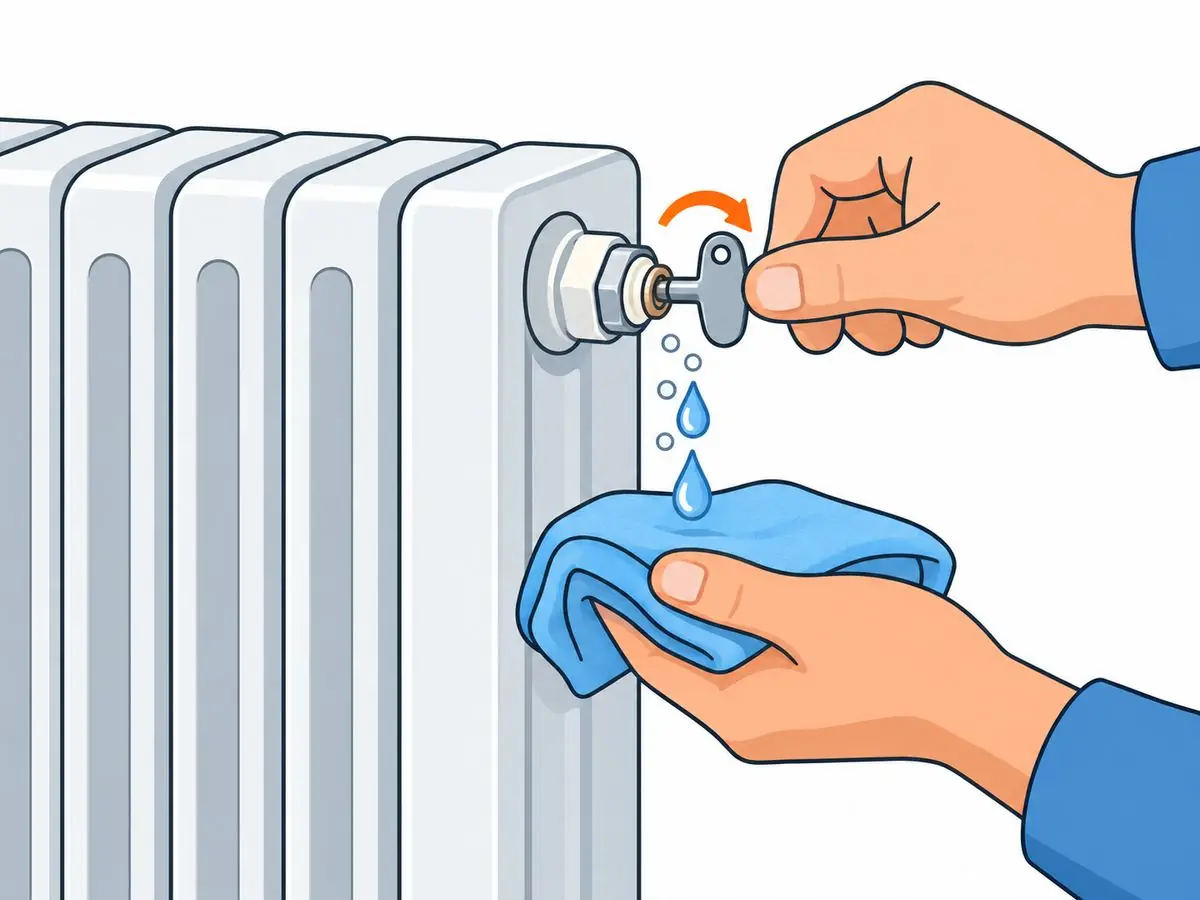
Here is how to bleed a radiator that stays cold at the top, using a key and a rag. When the top of a radiator stays cold while the bottom is warm, trapped air is the usual cause. Air collects in the high point and blocks hot water. The radiator heats poorly, and the room stays cool. Bleeding releases the air so water fills the radiator again. Many people do it at the start of each heating season.
This guide is part of our wider guide to heating, cooling and air quality.
Make sure it is air, not something else
Turn the heating on and let it run for a while. Feel each radiator. If the top is cool and the bottom is hot, you have air. If the whole radiator is cold, the issue may be a stuck valve, a closed valve or a sludge problem. If it is cold at the bottom and hot at the top, there may be a blockage inside, which is a job for a heating technician.
Gather what you need
Most radiators have a small bleed valve on one upper corner with a square or slotted stem. A radiator key from a hardware store fits the square type. Keep a towel and a small cup ready.
Turn off the system
Turn the heating off at the thermostat. Wait until the radiators are cool and the pump has stopped. If the pump is running, the system can pull air in through the open valve.
Open the valve slowly
Hold the cup and towel under the valve. Put the key on the valve stem. Turn it a quarter turn counterclockwise. Do not take it fully out. You will hear a hissing sound as air comes out.
Wait for the hiss to stop. A little spit or a few drops of water means the air is out. Close the valve by turning it clockwise, snug but not too tight.
Do the rest of the house
Start with the radiator closest to the boiler on the lowest floor, then work up and out. Air can move between radiators, so bleed them in that order.
Check the boiler pressure
Releasing air and water lowers the system pressure. Look at the pressure gauge on the boiler. The correct range is marked in the manual, and a typical home system sits at about 12 psi when cold, but check yours. If it has dropped below that, top it up by the filling method in the manual, or call the installer. Do not add water if you are not sure how.
Turn the heating back on
Run the system and check each radiator. All should heat evenly. If a radiator still has a cold spot after bleeding twice, call a technician.
Why air gets in
New air often comes from a recent refill, a small leak or a worn automatic air vent. If you need to bleed several radiators every few weeks, have the system checked.
What to avoid
Do not bleed radiators while the heating is on. Do not open the valve fully. Do not ignore a leak at the valve. Do not mix this up with a steam radiator, which can have a vent that is meant to let steam out.
For other heating help, see our guide to changing a furnace filter if you have a forced-air system.
Related guides
- Dryer Not Heating but Running? 6 Checks Before You Call for Repair
- How to Insulate a Basement Rim Joist to Stop Drafts and Cold Floors
- How to Insulate an Attic Hatch and Stop Heat From Escaping
- How to Get Rid of a Musty Basement Smell by Fixing the Cause
- How to Set a Thermostat Schedule to Save Energy Without Losing Comfort
FAQ
How often should I bleed radiators?
Once a year is common, or when a radiator is cold at the top.
Why is water coming out?
That means the air is out. Close the valve.
Can I bleed a steam radiator?
No. Steam systems have different vents. Ask a pro.
More from this topic
- How to Clean Baseboard Heaters for Better Heat: Learn how to clean baseboard heaters: shut the power or heat off, vacuum the fins, wash the covers and get...
- How to Fix a Furnace That Blows Cold Air: Learn how to fix a furnace that blows cold air: check the thermostat, filter and pilot, and know when the...
- How to Fix a Shower That Won't Get Hot: How to fix a shower that won't get hot: check the limit stop, the cartridge and the water heater in order to...
- How to Fix a Towel Warmer That Won't Heat Up: Learn how to fix a towel warmer that won't heat up: bleed trapped air, balance the valves, check the...
- How to Insulate a Water Heater and Hot Water Pipes Safely: Learn how to insulate a water heater with a blanket and pipe wrap: check if you need it, keep clear of vents...
 PlumbingHow to Fix a Shower That Won't Get HotHow to fix a shower that won't get hot: check the limit stop, the cartridge and the water heater in order to find the cause.BathroomHow to Fix a Towel Warmer That Won't Heat UpLearn how to fix a towel warmer that won't heat up: bleed trapped air, balance the valves, check the thermostat and clear a sludge-blocked towel warmer.
 PlumbingHow to Insulate a Water Heater and Hot Water Pipes SafelyLearn how to insulate a water heater with a blanket and pipe wrap: check if you need it, keep clear of vents and controls, and cut standby heat loss safely.