
How to Replace a Door Threshold to Stop Drafts and Water
Part of: Floors, walls and doors
- Difficulty
- Moderate
- Time
- 2 to 3 hours
- Tools
- Pry bar, hammer, utility knife, tape measure, saw, drill and screws, exterior sealant, silicone, level, chisel, replacement threshold, threshold seal kit
- Call a pro if
- The sill or the framing under the door is rotten, the door frame has moved, or the opening is not standard and needs custom fabrication.
In this guide
- Wear protection
A door threshold takes more abuse than any other piece of trim in the house: feet, weather, water running off the door, and the bottom edge of the door itself. When it rots, cracks or loses its seal, you get a draft, a wet floor and eventually a rotten sill. Replacing it is a straightforward job with a pry bar and a saw. How to replace a door threshold starts with what is under it, probing the sill and framing with a screwdriver before the old one comes out.
This guide is part of our wider guide to doors and windows.
1. Check what is under the old threshold
Before you start, look at the condition of the sill and the framing. Press a screwdriver into the wood under the door. If it sinks in or comes out wet, there is rot, and a new threshold on top of rot will not last.
Rot in the sill needs cutting out and replacing, which is a bigger job than a threshold swap. In that case, get a carpenter.
2. Measure the opening
Measure the width of the door opening, the depth of the threshold from the interior to the exterior, and the height of the existing threshold. Note whether the door has a sill pan or a metal cap.
Take the old threshold with you when buying a replacement, or take detailed photos and measurements. Thresholds come in standard widths but the depth and profile vary a lot.
3. Remove the old threshold
1. Score the paint or sealant along the edges with a utility knife.
2. Work a pry bar under one end and lift gently, working along the length.
3. Look for screws through the top of the threshold; many are hidden under a seal strip.
4. Pull the threshold out and clean the sill underneath.
Take care not to damage the door frame or the flooring on either side.
4. Deal with the opening
1. Scrape off old sealant and any loose material.
2. Check the sill for rot and treat any soft spots with a wood hardener if they are minor.
3. Clean the surface so the new threshold sits flat.
4. Check that the sill is level. If it is not, the new threshold will rock and water will get under it.
5. Fit the new threshold
1. Cut the new threshold to length, allowing a small gap at each end for the frame.
2. Dry fit it and check the door clears it through its full swing.
3. If the door rubs, you may need to trim the bottom of the door rather than lower the threshold, since the threshold needs to sit above the exterior grade.
4. Apply a bead of exterior sealant along the sill where the threshold will sit.
5. Fix the threshold with screws through the pre-drilled holes, countersinking so the heads sit flush.
6. Check it is level and that the ends meet the frame neatly.
6. Seal it properly
Water gets under a threshold at the ends and along the back edge.
1. Run a bead of exterior silicone along the junction between the threshold and the door frame at both ends.
2. Seal along the interior edge where the threshold meets the floor.
3. On the exterior, seal where the threshold meets the sill or the step, but leave any weep holes clear.
Use an exterior-grade sealant, not interior caulk.
7. Fit the door seal
Most thresholds come with, or accept, a seal strip or a sweep on the door.
1. Fit the seal strip into the threshold's channel.
2. Check the door closes onto it with a slight compression.
3. Adjust the door's sweep or the threshold height if there is a gap.
A threshold with no seal still lets air in. The seal is the part that does the work.
8. Check the door still works
Open and close the door through its full swing. It should not rub, catch or need force. If it rubs at one end, the threshold or the sill is not level, or the door has dropped on its hinges.
Also check that the door locks and latches as before. A threshold that lifts the door can throw the lock out of alignment.
9. Finish and maintain
- Paint or seal a wooden threshold on all sides before fitting, especially the ends and the underside.
- Check the sealant every year and renew it when it cracks.
- Keep the exterior clear of leaves and dirt so water drains away.
- Check the door sweep too; our guide on fixing a gap under an exterior door covers that repair.
Common mistakes
- Fitting a new threshold over a rotten sill.
- Sealing all the way around, including the weep holes.
- Not sealing the ends, where water gets in first.
- Choosing a threshold that is too high, so the door has to be cut down.
- Using interior caulk outdoors.
Related guides
- How to Caulk Around a Window to Stop Drafts and Water
- How to Stop a Door From Slamming or Banging
- How to Fix a Storm Door That Slams or Will Not Close With the Closer
- How to Fix a Door That Will Not Latch (3 Simple Fixes)
- How to Install a Door Threshold
- How to Fix a Patio Door That Leaks Air or Water
FAQ
How do I know if my threshold needs replacing?
If it is cracked, rotten, loose, or the door lets in a draft or water at the bottom, it needs attention. A threshold that has lost its seal strip can sometimes just have the strip replaced.
Can I replace just the seal on a threshold?
Often yes. If the metal or wood body is sound, a new seal strip or sweep is enough.
Do I need to remove the door to replace a threshold?
Usually not. The threshold comes out from under the closed door, though the door may need adjusting afterwards.
What is the best material for an exterior threshold?
Aluminum with a thermal break, or a hardwood threshold that is sealed on all sides. Avoid untreated wood outdoors.
More from this topic
- How to Install a Door Sweep to Stop Drafts, Water and Pests: Learn how to install a door sweep: measure the gap, choose the right type, cut it to fit, fix it to the door...
- Gap Under an Exterior Door: A gap under an exterior door lets in cold air, bugs and water. Measure it, choose the right door sweep or...
- How to Replace Window Weatherstripping to Stop Drafts: Learn how to replace window weatherstripping: pick the right type, remove the old strip, clean the channel,...
- How to Weatherstrip an Exterior Door and Stop Drafts: Learn how to weatherstrip an exterior door: test for leaks, pick the right seal and install it along the...
- How to Caulk Around a Window to Stop Drafts and Water: How to caulk around a window where water gets in: which joints to seal, which stay open, draft vs leak, and...
 Doors and WindowsHow to Install a Door Sweep to Stop Drafts, Water and PestsLearn how to install a door sweep: measure the gap, choose the right type, cut it to fit, fix it to the door without blocking the swing and seal the ends.
 Doors and WindowsGap Under an Exterior DoorA gap under an exterior door lets in cold air, bugs and water. Measure it, choose the right door sweep or threshold fix and install it in under an hour.
 Doors and WindowsHow to Replace Window Weatherstripping to Stop DraftsLearn how to replace window weatherstripping: pick the right type, remove the old strip, clean the channel, fit the new seal, and test the window for gaps.
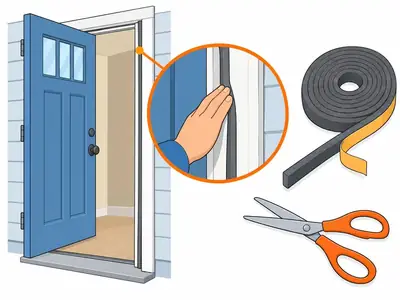 Doors and WindowsHow to Weatherstrip an Exterior Door and Stop DraftsLearn how to weatherstrip an exterior door: test for leaks, pick the right seal and install it along the sides and top so the door closes snug without sticking.
 Doors and WindowsHow to Caulk Around a Window to Stop Drafts and WaterHow to caulk around a window where water gets in: which joints to seal, which stay open, draft vs leak, and when the problem is flashing.